A nighttime street scene featuring a row of lit white colonial-style houses with wrap-around porches, flanked by oak trees draped in Spanish moss.

Heat Pump Repair in Arkadelphia, AR

Tell us about the job

Takes about a minute. No obligation.

RepairHeat PumpClark County, AR
Step 1 of 2

What ZIP code is the job in?

Storms knock out the power, not the heat pump

Clark County saw 65 severe weather events between 2015 and 2024, mostly wind and hail. What that usually means for a heat pump is a power outage, not damage to the unit itself. When power drops and comes back, most heat pumps restart on their own.


Check the thermostat and breaker first

If your heat pump went quiet after a storm, look at the thermostat and the breaker panel before assuming a part failed. A tripped breaker or a thermostat that lost its settings will stop a heat pump cold, and either one is worth ruling out before calling anyone out.

5 months
November through March, your system heats
5 months
May through September, it cools
33°F
the average winter night it heats against
91°F
the average summer afternoon it cools against
Isometric line illustration of a cutaway single-story house showing interior rooms with furniture and attic ductwork connected to an outdoor condenser unit beside the building.
Your system heats November through March and cools May through September.

NOAA nClimDiv, 1991–2020 normals

Half the homes in Clark County were built in 1985 or later.

A heat pump installed with a newer house still has years of working life, and that's usually worth repairing.

November is when a heat pump that limped through summer finally gives out

Cooling runs May through September
Heat runs November through March
Power costs 12.32 cents a kWh statewide

If your heat pump went in when the house was built, ask for a repair quote before a replacement quote. A failed capacitor, a bad contactor, a low charge, these are single-part fixes and a system that age is a good candidate for one. Mobile homes make up close to 15% of the housing here, and a heat pump in one works the same way and wears the same parts as any other. Either way, the question is what actually failed, not how old the unit is.

Get the usual fix

Nothing about this area is especially hard on it. It's most likely the usual problem with the usual fix.

Find a contractor
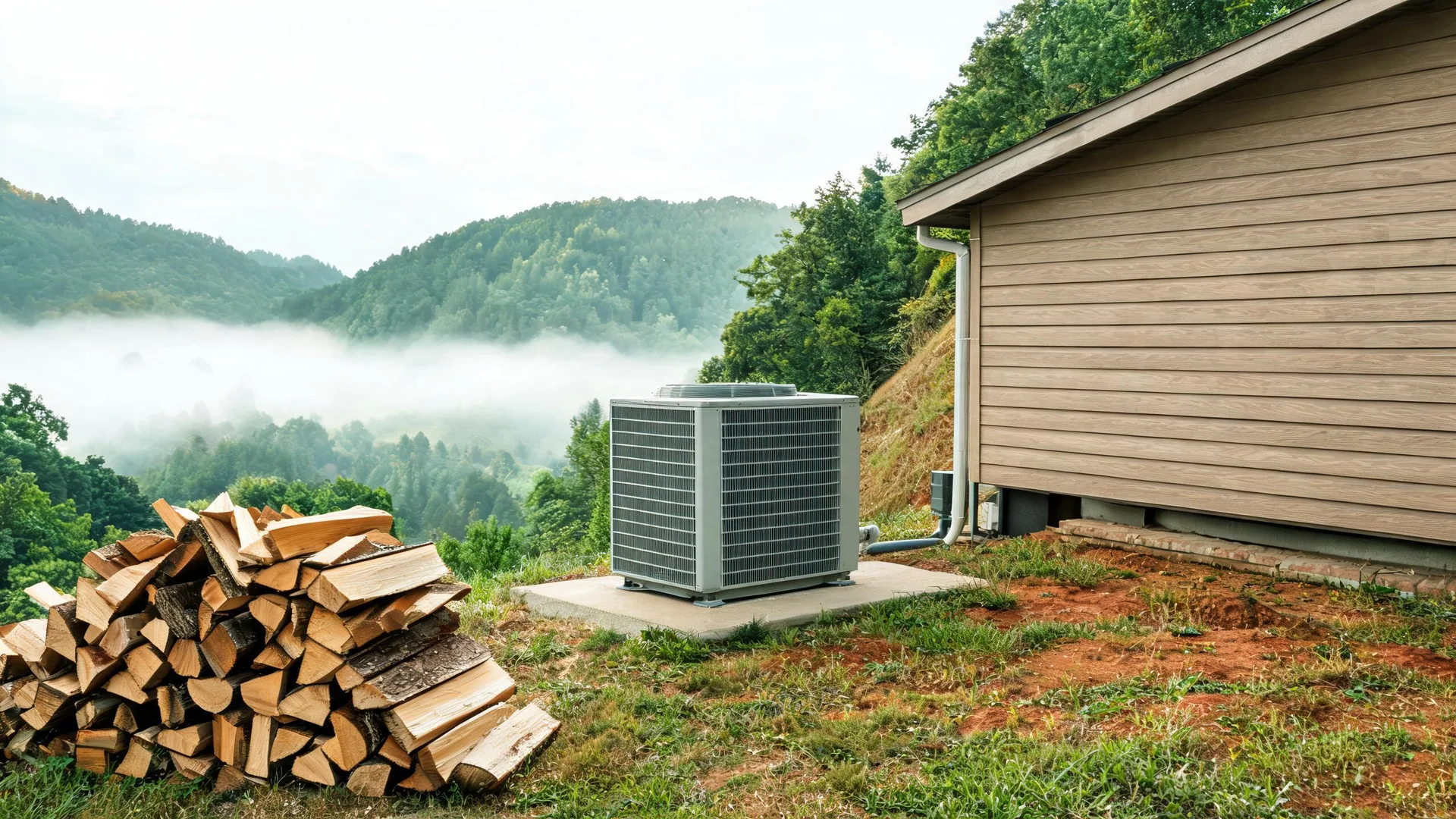
A gray outdoor HVAC unit mounted on a concrete pad beside a house with gray lap siding and a stone foundation.

Left running, a small problem becomes a bigger one

A heat pump that's struggling doesn't fail all at once. It gives off signs first, and running it through those signs is what turns a small repair into a bigger one. A compressor working against a low refrigerant charge runs hotter than it should, and heat is what wears a compressor down. Ice on the outdoor coil blocks airflow, so the system runs longer to do the same job, and that longer runtime is hard on the parts around it. A failing capacitor makes the compressor or fan motor draw more current trying to start, and that strain shortens what's left of its life. None of these fix themselves by staying on. The unit just keeps working against whatever's already wrong, and the part that's struggling keeps struggling until something gives out.

The reversing valve is the part that's unique to a heat pump

A reversing valve switches the system between heating and cooling by changing which way the refrigerant flows. A furnace or a straight air conditioner doesn't have one, and it's a common point of failure. A valve stuck in one position leaves the system blowing cold air when it should heat, or unable to switch over at all.

Most other failures are the same ones any AC has

The capacitor that starts the compressor and fan motors wears out over time and is a frequent cause of a system that hums but won't start. A dirty outdoor coil makes the whole system work harder and run longer. A low refrigerant charge, usually from a slow leak, cuts into both heating and cooling capacity. None of these are particular to a heat pump, and all of them are routine to diagnose.

Before calling anyone, check a few things that take less than a minute. Look at the thermostat first. Make sure it's set to heat, not cool, and that the set temperature is actually above room temperature. Go to the breaker panel and look for a tripped breaker on the heat pump's circuit, both inside and at the outdoor unit if it has its own disconnect. Walk outside and look at the outdoor unit itself. If the coil is caked in ice, or buried under leaves and debris, that will stop it from working right regardless of what else is going on. Check that the outdoor fan is actually spinning when the system calls for heat. If the air filter inside hasn't been changed in a while, swap it out, since a clogged filter chokes airflow all the way through the system. None of this tells you what's broken if something actually is, but it rules out the few things you can fix yourself before paying someone to find a tripped breaker.

A heat pump that won't start and one that runs but doesn't heat well point to different things. A no-start is usually electrical. A capacitor, a contactor, or a control board has failed, and replacing that one part brings the system back to full strength. A heat pump that runs but struggles is a different story. Short cycling, weak heat, ice that keeps coming back, these point more toward refrigerant or airflow, something mechanical wearing down rather than one part failing clean. Neither kind of problem is a reason to replace the unit on its own. What matters more is whether this is the first repair or the third. A system that keeps coming back for different problems is telling you something a single bad part isn't.