Heat pump running all the time in Searcy, AR

Hand off the search

A heat pump that never shuts off in a Searcy summer usually means it's losing the fight against the heat and humidity, not that it's working as it should. Cold snaps put the same strain on it from the other direction. Either way, a unit that runs constantly is wearing down parts that were never built to run nonstop, and on electric rates, that adds up fast. You don't need to spend your afternoon calling around White County to find out why. Fill out the form and a licensed local contractor who works on heat pumps all year in this area, in both the heat and the cold, takes it from there. You'll hear from one contractor, not a handful competing for your call. Someone who already knows what tends to go wrong with heat pumps around here gets matched to your situation, and the job of finding help stops being something you have to carry.

Why does my heat pump run constantly in Searcy?

A heat pump that runs nonstop through a Searcy summer or a hard cold snap is usually struggling to keep up, not working the way it should. You want to know whether this is normal for the weather here or a sign something needs looking at, and what it means for the system and the power bill if it keeps running this way.

Most likely it's losing a fight it should be winning

A heat pump that keeps running almost always means it can't move enough heat to satisfy the thermostat, so it never gets there and never shuts off. In White County summers, long stretches of heat and humidity push a unit hard, and a system low on refrigerant or with a dirty coil can run for hours without the house cooling down. Cold snaps do the same from the other side, forcing the compressor to work longer for less heat moved. Since most homes here heat with electricity, a unit stuck running pulls power the whole time, even though power here is priced low. The constant runtime also wears the compressor faster than normal cycling would. It's worth having someone check it rather than assuming it's just the weather.

An outdoor condenser unit beside a horizontally sided house, encased in thick ice with hanging icicles, on a snow-dusted ground at sunset with bare trees in the background.

You're out before work, coffee still in hand, and you walk around the side of the house to check the propane tank gauge. It's just past six, still dark, maybe 20 degrees. The outdoor unit is running, same as it has been all night, and you stop. Ice has built up over the whole cabinet, thick across the coil fins and down the side panel. Not the thin frost you've seen before. This is solid, the kind you'd need to chip at. The fan is still turning under it, straining. You stand there a second, breath fogging, and head back inside to call someone before you leave for work.

What are you noticing with your own system

You've probably stopped hearing it as a sound and started noticing it as a fact: the outdoor unit is always on. Indoors, the air coming out of the vents feels cool but weak, and the house never quite gets to the temperature on the thermostat no matter how long you wait. In summer you might notice the indoor air feels damp even with the AC running, since a system that can't keep up often fails to pull moisture out of the house along with the heat. In a cold snap, you may see the outdoor unit coated in ice or hear it cycling into defrost over and over. Either way, your power bill is the other thing you're noticing. A heat pump working this hard, this long, is using more electricity than it should, and the strain can shorten how long the unit lasts.

A gray-haired bearded man in a dark knit sweater sits on a light gray sofa in a sunlit living room, looking to his left, with a framed artwork, a potted palm, and a curtained glass door behind him.
A middle-aged man in a dark green sweater sits on a light grey sofa looking toward a sunlit window, with a wooden shelving unit, lamp and potted plants in the background.
A man in a dark green sweater sits on a light grey sofa in a sunlit living room, looking to his left, with a shelving unit, houseplants, framed art and a large window behind him.
A gray-haired bearded man in a dark green sweater sits on a light gray sofa in a sunlit living room with a potted plant, framed picture, and dark shelving in the background.
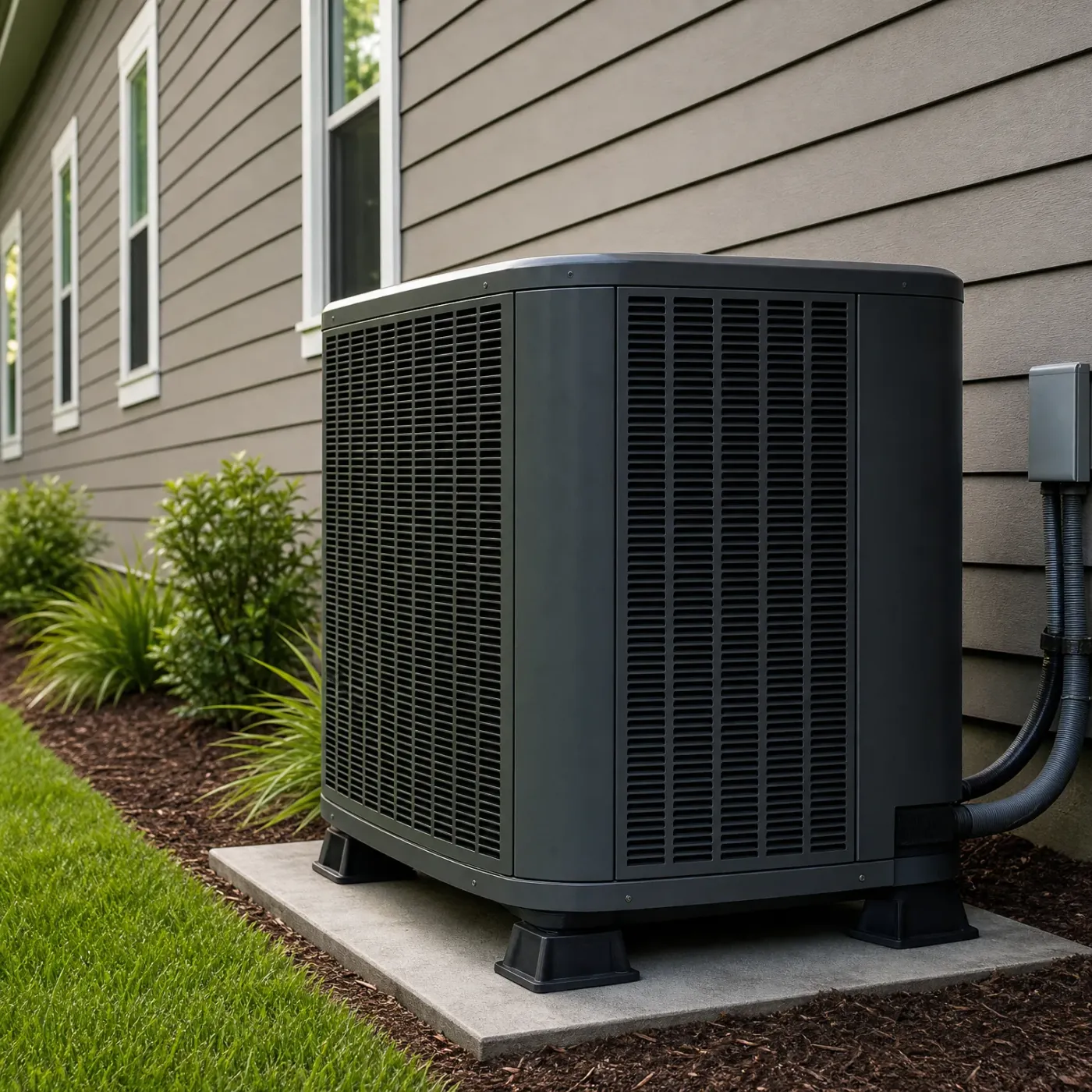
A gray outdoor condenser unit sits on a concrete pad beside a house with horizontal lap siding, with a wall-mounted disconnect box and refrigerant lines, mulched beds and a shrub nearby, and a concrete walkway in the foreground.
A heat pump like this one is sized right and cycling normally, shutting off once the house reaches the set temperature.
An outdoor air conditioner condenser unit on a concrete pad beside a light gray vinyl-sided house, with an electrical disconnect box and conduit on the wall and bare soil in the foreground.
Here, the unit runs nonstop and never satisfies the thermostat, a sign something is keeping it from catching up.

A heat pump doesn't burn fuel to make heat. It moves heat from one side of the house to the other, and a reversing valve decides which direction that goes, cooling in July, warming in January. That's why the outdoor unit works harder as the temperature drops. On a cold morning it has to pull what heat it can out of outside air, and the colder that air gets, the longer the compressor has to run to keep up. Periodically the system reverses itself on purpose, running the outdoor fan to melt frost off the coil, then switches back to heating. That's normal. What isn't normal is a thermostat set point the system never reaches, because that keeps the compressor running straight through instead of cycling off like it should. A low refrigerant charge does something similar, since the coil can't absorb or release as much heat as it's supposed to. And sometimes the problem is simpler than any of that: a weak capacitor or a failing compressor trying and failing to build up to full output, over and over.

How a heat pump actually runs

  • A heat pump moves heat instead of making it, so it leans on a reversing valve to switch between cooling your house in July and warming it in January.
  • The outdoor unit has to pull heat from outside air even on a cold January morning, which is why it works harder as the temperature drops.
  • Every defrost cycle briefly reverses the system and runs the outdoor fan to clear frost off the coil before switching back to heating.
  • A thermostat set point the system can't reach keeps the compressor running continuously instead of letting it cycle off at the usual intervals.
  • Low refrigerant charge reduces the heat the coil can absorb or release, so the compressor keeps running to make up the difference.
  • A failing capacitor or a weak compressor can keep the unit cycling on attempts without ever building up to full output.
A woman with shoulder-length graying brown hair in a cream knit cardigan sits in a dark armchair indoors, looking off to the side with a slight smile, with a shelf, window and houseplant blurred behind her.
A woman with her hair in a bun holds a sleeping boy against her shoulder, both wrapped in a thick cream knit blanket on a couch in a dim room with a lit lamp, potted plants and a shelf behind them.
A gray outdoor condenser unit on a concrete pad beside a light-colored horizontal-siding house, with a disconnect box and refrigerant line on the wall, ornamental grasses and a shrub in mulch nearby, and a concrete patio in the foreground.

Running, but catching up

The outside unit cycles on when the house calls for it and shuts off once the thermostat is satisfied. The lines stay clear, the pad is clean, and the disconnect box sits untouched. This is a system keeping pace with a Searcy afternoon, not fighting it.

An outdoor condenser unit sits on a concrete pad beside a house with horizontal vinyl siding, with a gray electrical disconnect box and conduit on the wall and a shrub at left.

Running, and not catching up

Here the unit is on the same pad, same lines, same disconnect box, but it never shuts off. Nothing about it looks damaged from the outside. The trouble is what you can't see: a part inside working harder than it should, with nothing to show for it indoors.

An outdoor air conditioner condenser unit on a concrete pad beside a house with horizontal lap siding, with refrigerant lines entering the wall and a shrub on bare soil to the left.
Before you get your heat pump repair
A gray outdoor condenser unit on a concrete pad beside a light green lap-sided house, with a wall-mounted electrical disconnect box, mulch bed with shrubs, river rock, and a paved walkway in the foreground.
After you get your heat pump repair
A dark gray outdoor condenser unit on a concrete pad beside a house with horizontal lap siding, with mulch beds, shrubs, and lawn nearby and conduit running to a wall-mounted box.

Hand off the search today

Your request stays with one local pro.

Send the request and finding a pro stops being your problem.

Find a licensed heat pump pro

You only hire the pro if you want to.

Power here costs 13.30 cents per kilowatt-hour

At 13.30 cents per kilowatt-hour, running your heat pump nonstop costs you more by the week than a normal cycling pattern would. A unit that short-cycles the way it should keeps that bill in check. One that runs all day and night is pulling power the whole time without ever catching up.

EIA-861 2025

A heat pump is built to cycle. The compressor turns on, pulls the house down to the set point, and shuts off, often several times an hour depending on the weather outside.

If yours runs straight through without stopping, that's the compressor working beyond its normal pattern, and that kind of strain is what leads to a failed part before its time.

How long does your heat pump have to keep up with Searcy weather

  • Winter nights average 33°F

    Winter nights here average 33°F, cold enough that your heat pump has to pull heat from outside air for hours without a break.

  • Heat runs November through April

    Heat runs November through April here, six months of nights where a struggling unit gets no real rest between cycles.

  • Cooling runs May through September

    Cooling runs May through September here, five months where a unit that can't keep up stays on through the heat of the day and the night after it.

NOAA nClimDiv 1991-2020

A gray outdoor condenser unit on a concrete pad beside a house with horizontal lap siding, connected by conduit and lines to a wall-mounted disconnect box, with a shrub and gravel bed to the left.

Clean unit, clear airflow

This is what a heat pump should look like outside. The coil guard is clear, the lines running up to the disconnect box are unobstructed, and air moves through the fins the way it's supposed to. A unit kept this way can cycle on and off like it should instead of running straight through.

An outdoor air conditioner condenser unit on a concrete pad beside a house with horizontal lap siding, with refrigerant lines and a gray electrical disconnect box on the wall, surrounded by bare dirt.

Caked coil, blocked airflow

Dirt and debris have built up over the coil guard and fan grille until the unit can barely pull air through it. A heat pump working this hard against its own buildup struggles to move heat in either direction, which is often why it ends up running nonstop instead of shutting off.

A heat pump that never shuts off isn't doing its job, no matter how hot or cold it gets outside. It should cycle, catch up, and rest, and if it isn't doing that in Searcy, something in the system is failing to keep up. A contractor who works on these units every summer and every cold snap in this area knows the handful of things that usually cause this, from a low charge to a reversing valve stuck in one position, and checks those first instead of guessing. You'll get matched with one licensed contractor local to Searcy, not a handful of companies competing for the job, so there's one call to track and one person who already has a sense of what's likely wrong before they look at your unit. Once you send the request, the search is off your plate. Your heat pump should turn off sometimes. Getting it there is the point.

A single-story stone-clad house with low-voltage path lights along a gravel bed and lawn at dusk, with a tree line and orange sky on the horizon.

Heat Pump Repair

Stop chasing a heat pump pro

RepairHeat PumpWhite County, AR
Step 1 of 2

What ZIP code is the job in?

  • A cream upholstered armchair with a textured pillow sits in a corner beside a small round wooden side table holding a vase of greenery and a book, under a framed landscape print, with a potted tree in a woven basket and a sheer curtain nearby.
    • Tell a local repair pro what your heat pump is doing.
    • Describe your heat pump job, and a local pro who handles it gets in touch.
  • A beige upholstered armchair with a green cushion and knitted fringed throw sits in a corner beside a wooden side table holding a stone vase of leafy branches, under a framed landscape picture, on a woven rug near a sheer curtain.
    • One request and the search for a pro is handled.
    • Send it once and finding someone is no longer on you.
  • A wood-framed armchair with light beige upholstery and a gray linen cushion sits in a corner beside a potted olive-like tree and a sheer curtain at a window, with a framed picture on the wall above.
    • One form replaces the calls you'd make to find a heat pump pro.
    • Describe what your heat pump is doing once, in one form.
  • A ceramic vase holding leafy branches sits on a round wooden side table beside a sofa with a dark green cushion and gray throw, next to a sunlit window.
    • Your request goes to one pro, not a list of companies.
    • The pro who gets in touch is licensed in Arkansas and works in White County.