An outdoor heat pump unit mounted on a concrete pad in front of a two-story suburban house.

Heat Pump Repair in Bull Shoals, AR

Tell us about the job

Takes about a minute. No obligation.

RepairHeat PumpMarion County, AR
Step 1 of 2

What ZIP code is the job in?

Real winters, real summers, nothing extreme

Marion County asks for both heating and cooling, and the air runs humid. A heat pump here works both directions most of the year, but it isn't fighting the kind of brutal heat or deep cold that wears a system down fast.


That's good news for a repair call

A heat pump that hasn't been pushed to its limits season after season is more likely to have life left in it. If yours is acting up, age or a worn part is a more likely cause than years of strain, and that usually means fixing it makes sense.

7 months
October through April, your system heats
5 months
May through September, it cools
28°F
the average winter night it heats against
88°F
the average summer afternoon it cools against
Isometric line illustration of a cutaway house showing interior rooms with furniture, ceiling ductwork under a dark shingled roof, and an outdoor condenser unit connected by lines on the right.
Your system heats October through April and cools May through September.

NOAA nClimDiv, 1991–2020 normals

Half the houses in Marion County were built in 1986 or later.

A heat pump that came with a newer house still has years of work left in it, which is a good reason to fix it instead of replacing it.

Marion County gets its share of weather, but nothing that singles out a heat pump

67 severe weather events from 2015 to 2024
24% of homes statewide lost power a day or more in 2024
26 damaging wind events from 2015 to 2024

September is the month to get a heat pump looked at here. Heat runs from October through April, seven months straight, so whatever is wrong now is what it has to carry all winter. A system that gets by in mild weather can quit the first time it has to work hard. That first cold snap in October is usually when it happens. Getting it looked at in September leaves time to order a part if one is on back order.

A fair run here means it's usually worth fixing

Your heat pump has had a fair run here, not a hard one. If it's acting up now, that points to a part worn out or a part that failed, something a repair can usually fix. Worth getting it checked before it has to carry a full winter.

Find a contractor
A man in a cap, dark jacket and tan work pants carries a canvas tool bag up concrete steps toward a dark blue front door, with a potted shrub beside the entry.
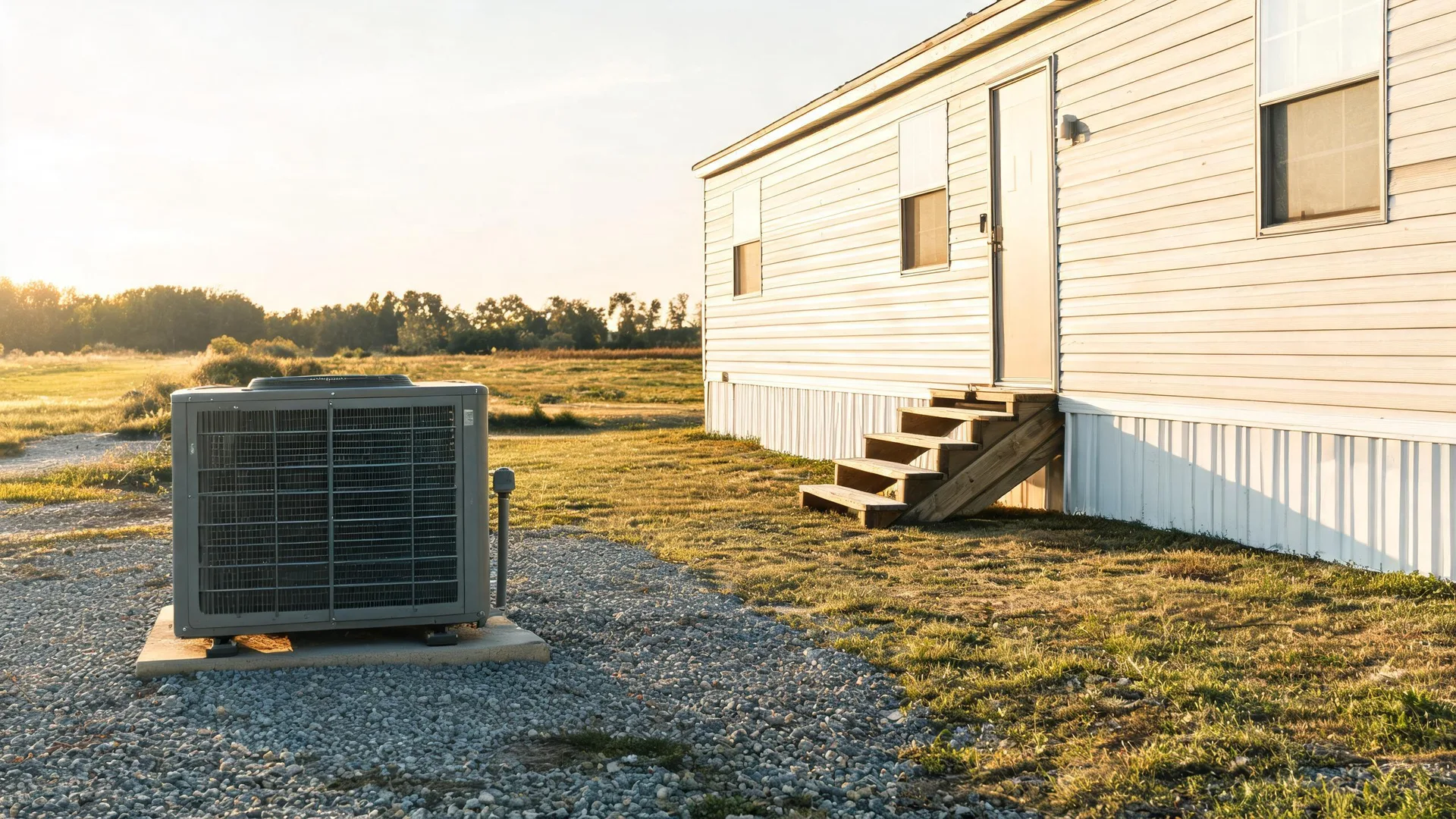
A gray heat pump outdoor unit mounted on a concrete pad next to a residential house with lap siding and stone accents.

Check the warranty before you call

If the house was built recently, check what came with it before the appointment. A unit still inside its original warranty may have the part covered, even if you weren't the one who bought it. Worth finding the paperwork or the model number before the contractor shows up.

A refrigerant leak doesn't hold steady

A heat pump low on refrigerant will still run, and that's the problem. The compressor keeps trying to move a full charge that isn't there, which runs it hotter than it's built for. Left alone, a small leak turns into a failed compressor.

A struggling system freezes itself

Weak airflow or a low charge lets the outdoor coil get too cold, and ice starts to build on it. Keep running the system and that ice spreads, blocking airflow further, which drags the charge down more and grows the ice faster. It ends up a block of ice that has to thaw before anyone can even see what started it.

A heat pump fails the same handful of ways no matter whose house it's in. The reversing valve is usually the first thing to act up, since it's what switches the system between heat and cool, and a stuck valve leaves you blowing cold air when you asked for heat. The defrost board is another common one. It's supposed to clear frost off the outdoor coil on a schedule, and when it fails the coil ices over and airflow drops until the system can barely move heat at all. Outside, the fan motor and capacitor take the brunt of being out in the weather year-round, and a weak capacitor shows up as a unit that hums but won't start. None of these are wear from hard use so much as parts reaching the end of what they're built to do.

A heat pump that's never given trouble before and suddenly is usually just needs one part back in working order. Repair makes sense when the system has been reliable and the failure looks like a single part, a capacitor, a contactor, a control board. It's a different story when the unit keeps coming back with something new each time it's fixed. A system nearing the end of its working life tends to show that by failing in different ways, not the same way over and over. If a contractor finds the compressor itself is the problem, that's worth weighing carefully, since it's the most expensive part to replace and doing so can cost close to starting fresh. For everything else, a worn part is just a worn part, and fixing it is usually the right call.