Three white clapboard houses with wraparound porches glow with warm interior and landscape lighting beneath Spanish moss-draped oak trees at dusk.

Heat Pump Repair in Cabot, AR

Tell us about the job

Takes about a minute. No obligation.

RepairHeat PumpLonoke County, AR
Step 1 of 2

What ZIP code is the job in?

Warm air in heating mode, weak air in cooling mode

A heat pump that blows air you can't feel warm during winter is likely stuck in defrost or has a reversing valve that won't shift. The same valve stuck the other way can leave the system blowing air that never gets cold come summer. Either way the system is running but not doing its job, and the reversing valve is a common point of failure worth checking first.


Ice building up on the outdoor unit

Some frost on the outdoor coil during cold weather is normal and the unit should clear it on its own through a regular defrost cycle. Ice that keeps building instead of melting off points to a stuck defrost control, a failing sensor, or a fan that has stopped turning. Left alone, that ice blocks airflow across the coil and the system has to work harder to move any heat at all.

5 months
November through March, your system heats
5 months
May through September, it cools
34°F
the average winter night it heats against
90°F
the average summer afternoon it cools against
Isometric line illustration of a cutaway house showing interior rooms with furniture, ceiling ductwork connected to an indoor air handler, and an outdoor condenser unit linked by refrigerant lines.
Your system heats November through March and cools May through September.

NOAA nClimDiv, 1991–2020 normals

Half the homes in Lonoke County were built in 1997 or later.

A heat pump that age is usually a repair, not a replacement.

If it's original to the house, get it looked at before you plan to replace it

Half the homes here were built by 1997
54 hail events from 2015 to 2024
Power costs 12.32 cents a kWh statewide

Heat here runs November through March, so October is when a weak heat pump gets found out. The system switches from cooling to heating and leans on parts that sat idle all summer. A reversing valve that was sluggish back in May can stick for good once the cold hits it. Same with a defrost control that never quite worked right. Getting it checked in October, before the first cold morning, means the problem shows up on a technician's gauges instead of in a cold house in November.

Repair it

If your system came with a newer house, it likely has plenty of life left. Repair is usually the right call.

Find a contractor
A man in a dark jacket, cap and tan work pants carries a canvas tool bag up stone steps toward a navy front door, with a potted shrub beside the entry.
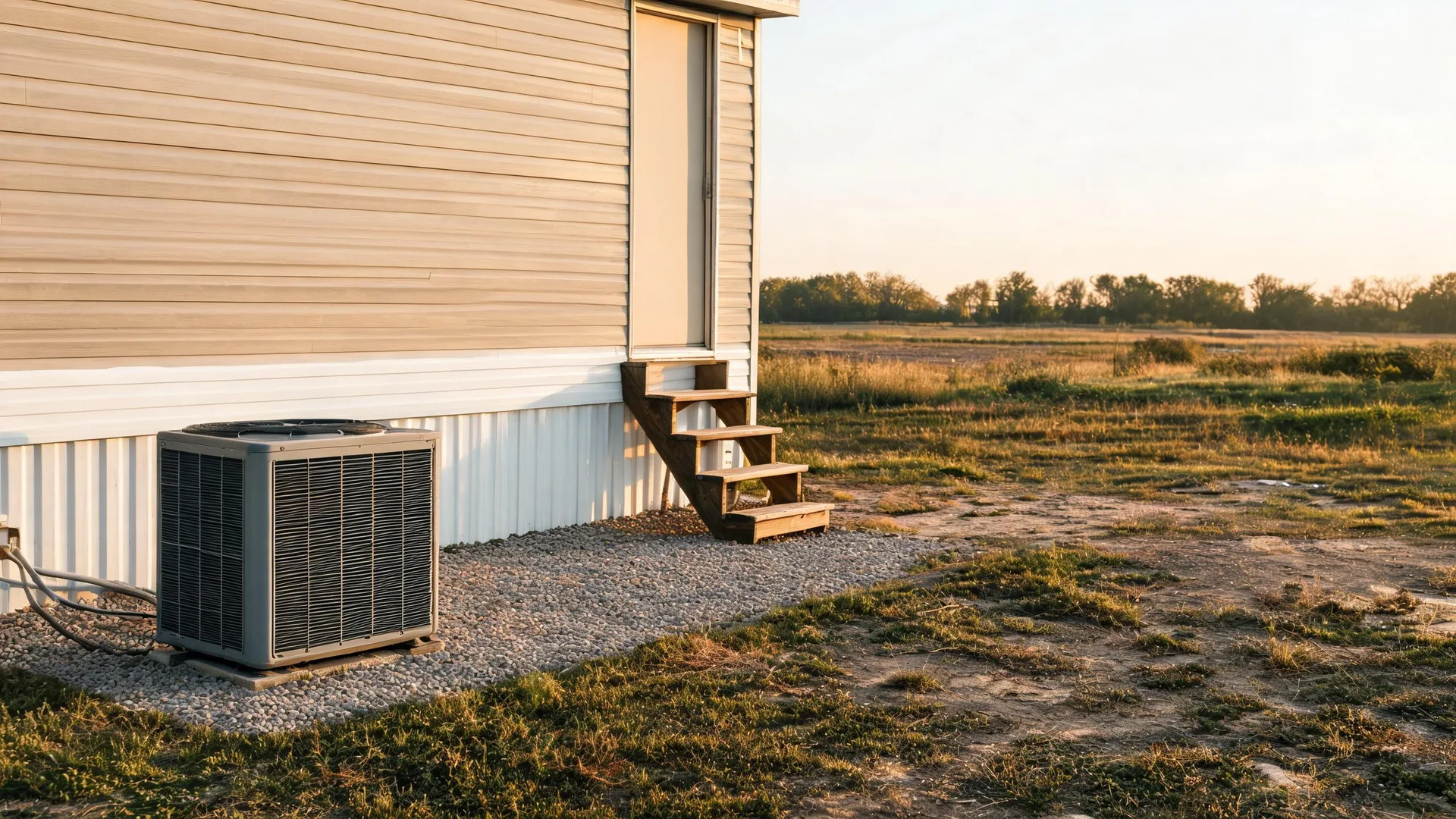
A dark gray heat pump unit mounted on a concrete pad next to a house with gray siding and a stone veneer wall.

Hail is part of what this system runs through

Lonoke County saw 54 hail events between 2015 and 2024. That's the outdoor unit taking a hit most years, sometimes more than once in the same season. A dented cabinet is just cosmetic, but hail bends fins, and bent fins choke airflow across the coil. The heat pump still has to pull heat out of the cold air or push it out into the hot air every day, hail or no hail, so a coil that can't breathe right is working against itself all season long. A unit already weak at the reversing valve or defrost control has less margin to make up for it.

The compressor rarely fails on its own

By the time a compressor quits, something else usually drove it there. Low refrigerant from a slow leak makes it run hot and strain with every cycle. A failed capacitor makes it try to start without the jolt it needs, which wears the windings down over time. Whatever let it get that far is worth finding, or a replacement compressor ends up in the same spot.

The small parts fail first

Contactors pit and stick from years of opening and closing. Capacitors weaken and stop giving the compressor and fan motor the start they need. Sensors drift and start feeding the control board bad readings. None of these are serious on their own, but left alone they drag a motor or compressor down with them, and that is how a small part turns into a major failure.

A heat pump that is struggling still tries to hit the temperature it's set to, so a weak system just runs longer to get there. That extra runtime is hard on whatever is already failing. A compressor working against low refrigerant gets hotter the longer it stays on. A fan motor with a going-bad bearing wears that bearing down faster the more it turns. A system that can't keep up will also short cycle, shutting off and restarting over and over, and each start is a jolt to the capacitor and contactor. None of this fixes itself by waiting. The parts under strain stay under strain until something gives, usually the next part in line rather than the one that started it.

A diagnostic visit starts outside at the unit itself. A technician checks refrigerant pressures and the temperature split between the air going into the system and the air coming out. That split says a lot about whether the charge is right and whether the compressor is pulling its weight. From there it moves to electrical. Capacitors get tested under load, contactors get checked for pitting, and the reversing valve coil gets checked to see if it energizes when it should. The system gets run in both heating and cooling, because a reversing valve that shifts fine one way can stick the other. Sensors get checked against what the control board is actually reading, since a sensor reading wrong will tell the board to make a bad call even while the sensor still has power. None of this is guesswork. The gauges and meters either show a problem or they don't.