A lit antebellum-style two-story house with white columns and a wraparound porch at night, framed by live oak trees draped in Spanish moss.

Heat Pump Repair in El Dorado, AR

Tell us about the job

Takes about a minute. No obligation.

RepairHeat PumpUnion County, AR
Step 1 of 2

What ZIP code is the job in?

A small problem feeds on itself

A heat pump low on refrigerant makes the compressor work harder to move heat out of the house. That extra strain shows up as more heat inside the compressor and more wear on it. Keep running it that way and what starts as a refrigerant leak ends as a failed compressor.

Ice does not stay put

A coil that starts icing over blocks airflow across it, so the system pulls in less heat and runs longer to make up for it. The longer it runs iced up, the more of the coil gets covered. Left alone, the unit ends up pushing air over a block of ice instead of a working coil.

5 months
November through March, your system heats
5 months
May through September, it cools
35°F
the average winter night it heats against
92°F
the average summer afternoon it cools against
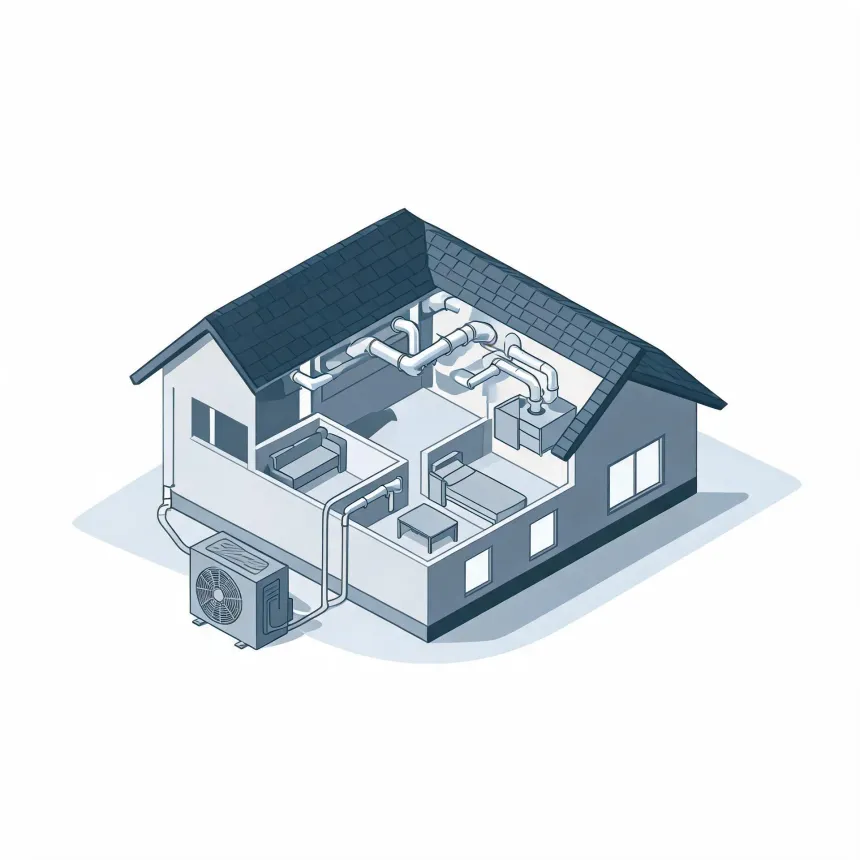
Isometric cutaway illustration of a house showing attic ductwork, an indoor air handler, furnished rooms, and an outdoor condenser unit connected by lines along the exterior wall.
Your system heats November through March and cools May through September.

NOAA nClimDiv, 1991–2020 normals

Half the homes in Union County were built in 1979 or earlier.

A heat pump fails from a worn part, not from the year on the house.

November is when a weak heat pump gets found out

Cooling runs May through September
Heat runs November through March
Power costs 12.32 cents a kWh statewide

A technician starts by asking what the system is doing. Short cycling, running nonstop, blowing air that isn't warm, not responding at all. That answer points to where they look first. They'll check refrigerant pressures, because low charge shows up fast and explains a lot of symptoms at once. They'll check the reversing valve too, since a heat pump that blows cold air while it's supposed to be heating often has a valve stuck in the wrong position. Pulling the access panel, they'll look at the contactor and the capacitor, parts that wear out just from switching on and off thousands of times. Outside, they'll check the coil and the defrost board. A coil caked in ice points to a defrost cycle that isn't firing when it should. Most of this gets sorted out before anything gets opened up or replaced.

Get the usual fix

Nothing about this area is especially hard on it. It's most likely the usual problem with the usual fix.

Find a contractor
A residential heat pump outdoor unit mounted on a concrete pad next to a house with gray vinyl siding.

It never gets the off season other systems get

A heat pump runs in both directions, all year, so its parts wear differently than a furnace or an AC that gets a break for part of the year. The compressor switches between cooling and heating duty, and the reversing valve that controls which way it flows is switching with it. A valve that moves back and forth that much eventually sticks or wears at the seat. The contactor and capacitor wear the same way, from constant switching on and off, not from any one hard day. The defrost board and its sensors tend to fail quietly, and the first sign is usually ice building up on the outdoor coil because the system stopped clearing it on schedule. None of this is damage from a hard stretch of weather. It's what happens to a machine that never really gets to stop.

What you can check yourself

Look at the thermostat setting and the batteries in it first, since a dead or dim display can look exactly like a dead system. Check the breaker for the outdoor unit and the indoor air handler, both of them, since either one tripping stops the system. Look at the air filter. A filter packed with dust chokes airflow and can make the system blow weak air or ice up the coil. Walk outside and look at the unit itself. If the outdoor coil is covered in ice or snow, or leaves and debris are packed against it, that blocked airflow is doing real damage the longer it sits.

What to leave alone

Don't chip at ice on the coil or pour water on it to melt it faster. The coil fins bend easily, and a bent fin blocks airflow permanently in that spot. Don't keep flipping the breaker if it trips again right away. That usually means a short or a locked motor, and resetting it again just stresses the same part further. Don't pull the access panels looking for the problem. What's inside runs on refrigerant under pressure and line voltage, and opening it up without the right gauges tells you nothing you can use anyway.

A heat pump in trouble rarely stays quiet about it. You'll notice the air coming out doesn't feel warm, even though the system is running, or it runs and runs without ever seeming to catch up. Some systems short cycle instead, kicking on and off every few minutes instead of settling into a steady run. Others make a new noise, a buzz from the contactor or a grinding from a failing motor bearing. Ice on the outdoor unit is another one people catch, since it's easy to see just by walking outside. None of these tell you exactly what's wrong on their own, but they tell you something is, and they're worth paying attention to before the system stops responding at all.

Repair makes sense when the part that failed is a part on its own, a capacitor, a contactor, a defrost sensor. Swap it and the system goes back to running the way it did before. Replacement starts to make more sense when the failed part is the compressor itself, since that's the part moving the refrigerant and doing the actual work of heating and cooling. A compressor failure often means the system ran compromised for a while first, low on charge or starved for airflow, so it's worth asking the tech what pushed it there before deciding. Age matters less than people think. A heat pump that's been maintained, filters changed, coils kept clear, can outlast one that's been ignored even if the ignored one is newer. What matters more is whether this is the first repair or the third one this year. A system that keeps finding new ways to fail is telling you something a single fixed part can't undo.