Two single-story houses, one with red brick and one with light siding, behind a trimmed hedge and lawn under large oak trees draped with Spanish moss.

Heat Pump Repair in Hot Springs, AR

Tell us about the job

Takes about a minute. No obligation.

RepairHeat PumpGarland County, AR
Step 1 of 2

What ZIP code is the job in?

The tech checks the whole system, not just the symptom

A heat pump that won't heat might have a bad reversing valve, a low charge, or a frozen outdoor coil. The tech checks refrigerant pressures, looks at the compressor, and watches how the system switches between heating and cooling before deciding what's wrong. A diagnostic means finding the actual cause, not swapping parts until something works.

What you find out before any repair starts

Once the tech knows what's failed, you should hear what it is in plain terms, what it takes to fix, and whether it makes sense given the age and condition of the unit. Some repairs are quick. Others point to a bigger problem, like a compressor on its way out, where patching the immediate issue just buys a little time.

6 months
November through April, your system heats
5 months
May through September, it cools
33°F
the average winter night it heats against
90°F
the average summer afternoon it cools against
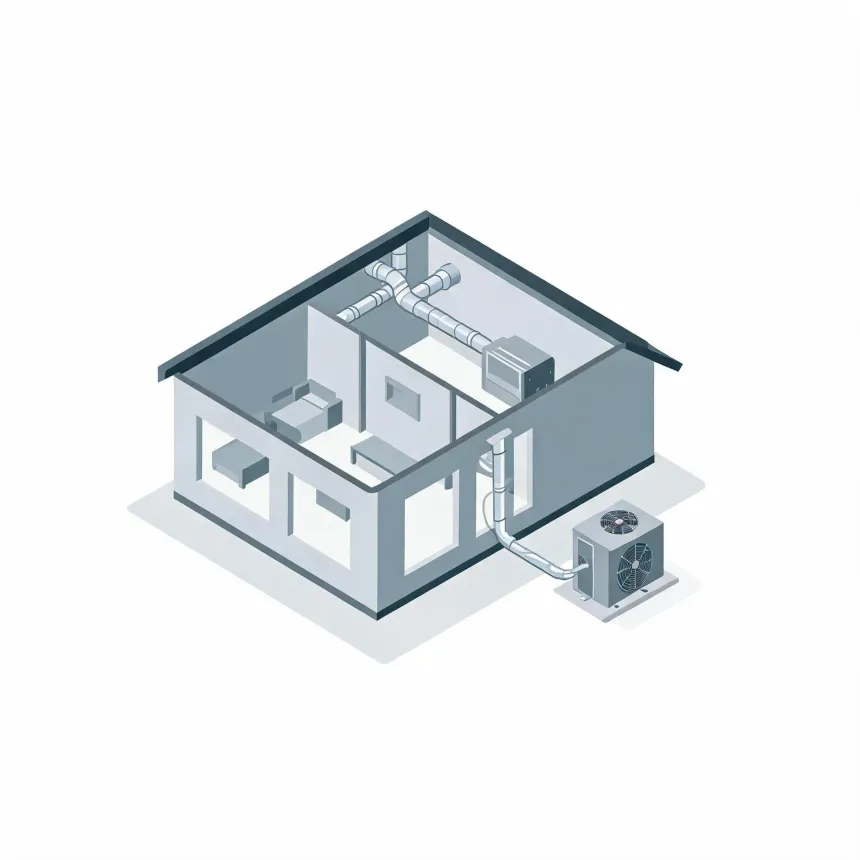
Isometric illustration of a cutaway house showing interior rooms, ceiling ductwork and an air handler, connected by lines to an outdoor condenser unit on a pad beside the building.
Your system heats November through April and cools May through September.

NOAA nClimDiv, 1991–2020 normals

Half the houses in Garland County were built in 1984 or later.

A heat pump that age still has years left in it, so a repair call usually makes more sense than a replacement quote.

A heat pump works hardest in its first cold snap and its first hot stretch

Cooling runs May through September
Heat runs November through April
57 hail events from 2015 to 2024
Garland County asks a lot of a heat pump57 hail events hit Garland County between 2015 and 2024, and the outdoor unit takes it

A heat pump that's struggling will keep trying to do its job until something gives out completely. Ice on the outdoor coil blocks airflow, so the system runs longer to move the same amount of heat, and that extra runtime stresses the compressor. A refrigerant leak gets worse under continued use too, since the compressor keeps pumping a shrinking charge through the system and can overheat doing it. A failing capacitor makes the compressor struggle to start, and every hard start wears it down a little more until it won't start at all. None of these get better by waiting. A system that's short-cycling or icing up or blowing the wrong temperature air is telling you something specific, and running it through that condition usually turns a part replacement into a compressor replacement.

Hail damage doesn't always show up right away

If your heat pump has been through one of those storms, a bent fin or a dented cabinet can sit there for weeks before the system starts struggling. A tech can check the coil and the cabinet and tell you whether that outdoor unit took a hit worth fixing now.

Find a contractor
A man in a cap, gray work shirt and dark pants, seen from behind, carries a worn canvas tool bag up porch steps toward a dark navy front door beside a potted shrub.
A white mini-split heat pump outdoor unit mounted on a concrete pad beside a gray-sided house, surrounded by gravel and green shrubs.

A newer system is still worth repairing

Half the houses in this county were built in 1984 or later, which puts a lot of heat pumps still well inside their working life. If yours is one of them, a failing part is usually worth fixing rather than a reason to replace the unit. Ask the tech what's actually worn out before you let anyone talk replacement.

Most failures come down to a few parts

The capacitor wears out and the compressor won't start. The defrost control board fails and ice builds up on the outdoor coil until airflow stops. The reversing valve sticks and the system blows cold air when it should heat. Contactors pit and burn from years of switching current. None of these are rare. They're the parts that work hardest every time the system cycles on.

Low refrigerant is a leak, not a top-off

A heat pump doesn't use up refrigerant the way a car uses gas. If the charge is low, it's low because it's leaking out somewhere, usually at a fitting, a coil, or a line connection. Adding refrigerant without finding the leak means doing it again in a few months. A tech should find where it's escaping before adding anything back in.

Before calling anyone, look at the outdoor unit itself. Check that it's not buried in leaves, pollen, or ice, and that nothing is sitting against the sides blocking airflow. Look at the coil fins for a layer of dirt or debris you could hose off from outside the cabinet. Check the thermostat is set to heat and the batteries aren't dead, since a dead thermostat can look exactly like a dead system. If there's a breaker for the outdoor unit, see whether it's tripped. If the outdoor fan isn't spinning at all, or if you see ice covering the coil, that's worth noting for the tech but not something to chip off or force yourself.

A heat pump close to the end of its life usually gives you more than one sign. If the compressor is failing and the coil is corroded and the system is low on charge all at the same time, you're not fixing a heat pump anymore, you're replacing parts around a cabinet that happens to still be standing. One bad part on an otherwise sound system is a different story. A compressor is the expensive part to replace, and a tech should tell you plainly if that's what's failed, because that's the repair worth weighing against a new unit. Ask what else the tech is seeing while they're in there. A system that's been well matched to the ductwork and gets serviced tends to fail one part at a time. One that's been ignored tends to fail all at once.