Two illuminated white Southern-style houses with wraparound porches and staircases, framed by a Spanish moss-draped tree on a quiet street at night.

Heat Pump Repair in Little Rock, AR

Tell us about the job

Takes about a minute. No obligation.

RepairHeat PumpPulaski County, AR
Step 1 of 2

What ZIP code is the job in?

A small fault spreads to other parts

A refrigerant leak starves the compressor of the cooling flow it needs, and running it low that way wears the compressor itself. A failing capacitor makes the fan motor strain to start, and that strain shortens the motor's life. The part that failed first is rarely the only part damaged by the time someone calls for help.


Ice and strain feed on each other

A heat pump low on charge or short on airflow will frost up the outdoor coil. Once ice builds, the unit can't pull heat the way it should, so it runs longer trying to catch up, and the extra runtime builds more ice. Shutting it down and calling someone stops that cycle before the compressor takes the hit.

5 months
November through March, your system heats
5 months
May through September, it cools
33°F
the average winter night it heats against
91°F
the average summer afternoon it cools against
Isometric cutaway illustration of a single-story house showing interior ductwork, an air handler and rooms, with an outdoor condenser unit connected by refrigerant lines on a plain white background.
Your system heats November through March and cools May through September.

NOAA nClimDiv, 1991–2020 normals

A heat pump blowing cold air in heating mode is still running, just not doing the job.

A reversing valve stuck in the wrong position causes that, and it won't fix itself.

Half the homes in Pulaski County were built in 1981 or later, and a heat pump that age is worth repairing

Half the homes here were built by 1981
178 damaging wind events from 2015 to 2024
97 hail events from 2015 to 2024

Heat here starts in November, so a heat pump that's been sitting idle gets asked for a full day's work with no warm-up. October is the month to get a weak one looked at, before that first cold stretch. A unit that struggled last March often has the same problem waiting in November. Heat pumps that run fine in the shoulder months can still fail outright once they're running for hours at a stretch instead of minutes. Catching it in October means a part gets replaced on a mild day instead of a cold one.

Repair it

If your system came with a newer house, it likely has plenty of life left. Repair is usually the right call.

Find a contractor
A man in a gray t-shirt and tan work pants, seen from behind, carries a canvas tool bag up wooden porch steps toward a dark blue front door beside a potted shrub.
A dark gray heat pump unit mounted on a concrete pad next to a house with gray siding and a stone veneer wall.

Check the install date before you replace anything

If your heat pump came with the house, the install date is usually on a sticker inside the unit, or in the paperwork from when you bought the place. A newer system acting up is still worth calling someone out for. Most of the time the fix is a part, not a full swap.

The defrost system fails quietly

A heat pump needs to reverse itself and melt off the frost that naturally builds on the outdoor coil in cold weather. That depends on a defrost thermostat or sensor and a timer or control board deciding when to kick it into that cycle. When the sensor reads wrong or the board stops triggering it, frost keeps building and never clears. The coil ices over for good, airflow drops, and the system runs hard without putting out heat.

The outdoor unit takes the abuse

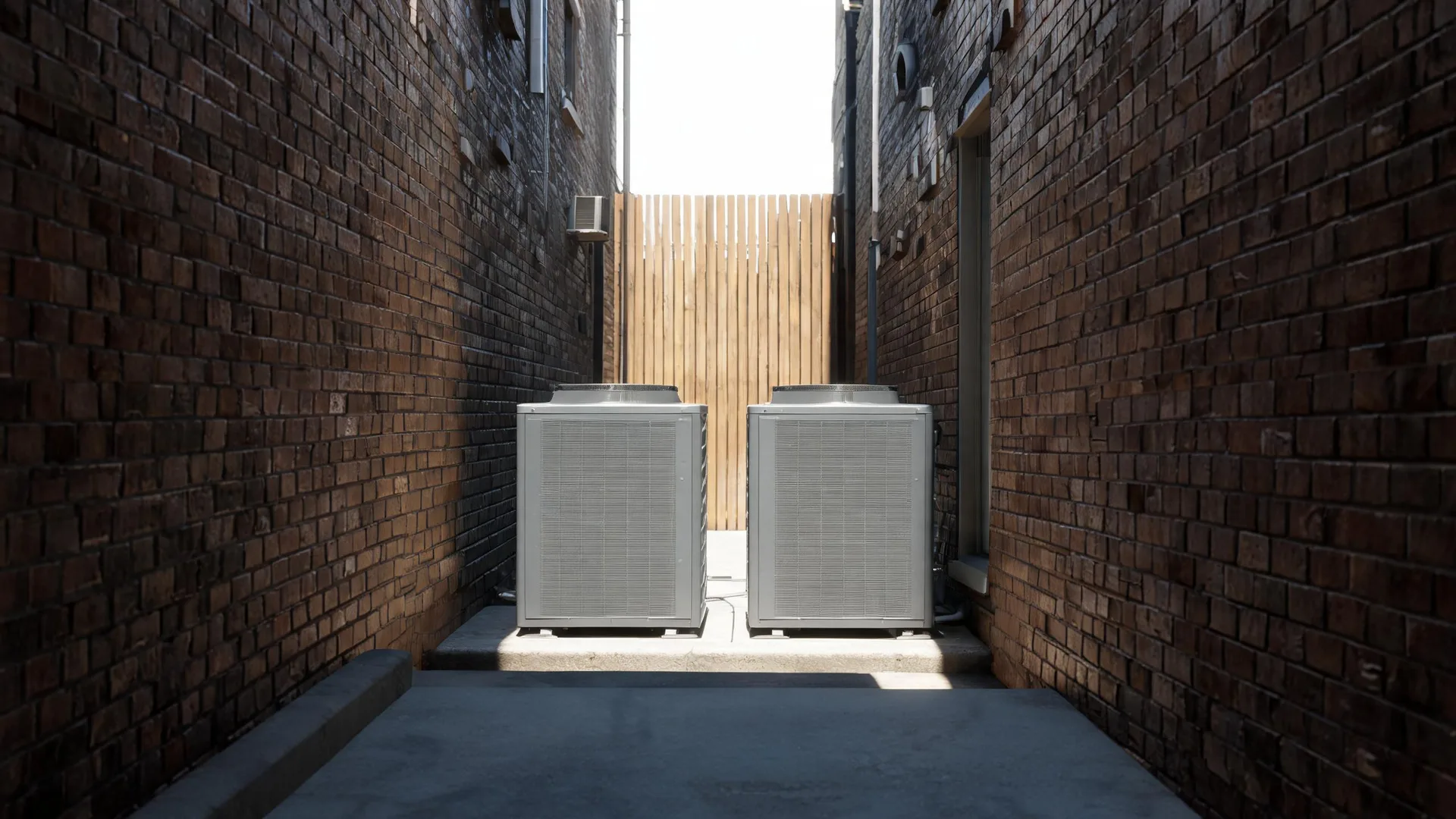
The outdoor unit sits outside year round, and that's where most failures start. The fan motor bearings wear from constant exposure, the contactor pits and sticks from switching the compressor on and off thousands of times, and the coil itself can corrode or get bent fins that choke off airflow. None of that shows up as one dramatic failure. It shows up as the system running longer, working harder, and eventually not keeping up at all.

Before calling anyone, look at the outdoor unit. If it's caked in ice or snow, that alone explains warm air that isn't warm enough. Check the thermostat is actually set to heat and not fan only, and that nothing's blocking the indoor vents or the return. Go outside and listen. A heat pump that's buzzing but not running, or cycling on and off without settling, is telling you something electrical is wrong, not something you can fix by waiting. Check the breaker for the outdoor unit hasn't tripped. If the air from the vents is cold and stays cold, and the outside unit isn't frosted, describe it exactly that way to whoever comes out, because it points straight at the reversing valve.

A diagnostic call starts outside at the unit, not with a clipboard of questions. The tech checks the refrigerant charge with gauges, because low charge explains weak heat and a frosted coil at the same time. They pull the electrical cover and test the capacitor and contactor, since a failing one puts strain on the compressor that shows up as a bigger failure later. They'll cycle the system into defrost manually to see if the reversing valve actually switches, or if it's stuck feeding the wrong temperature to the indoor coil. Airflow gets checked too, at the return and across the outdoor coil, because restricted airflow mimics a refrigerant problem and points a repair the wrong way. What separates a real diagnosis from a guess is testing each part under power, not just looking at it.