Describe your furnace job, and a local pro who handles it gets in touch.
A furnace that won't start on a cold night in Searcy isn't something to leave until morning. Most homes in White County heat with electricity, and when that system quits, there's no backup warming the house while you wait.
The cause could be something small. A thermostat with a dead battery, a tripped breaker, a filter so clogged the furnace shuts itself off to protect the blower. It could also be something only a licensed contractor should open up, like a failed igniter or a control board that's stopped sending power where it needs to go.
You don't have to figure out which one it is before you get help. Guessing wrong on a furnace, especially one that runs on electric heat, can mean a longer wait or a repair that didn't need to happen.
What you need is someone who already knows what fails on these systems and how to check it fast, so the house gets warm again without you troubleshooting a machine you didn't install and don't have to understand.
That's the part that gets easier from here. Once you send the request, you're not the one calling around White County looking for a contractor who's free. The matching happens on this end, and the contractor who serves your area reaches out to you directly. You go from having a cold house and no clear next step to having someone in it who already knows what you're dealing with.
Searcy winters get cold enough that a furnace down for days is a real problem, not an inconvenience. The faster a qualified contractor looks at it, the faster you know what it actually needs, whether that's a quick fix or something bigger.
Fill out what's below, and let someone who does this for a living take it from here.
A furnace that won't turn on usually comes down to power getting cut off somewhere between the wall and the burners. If yours runs on electric heat strips, check the breaker panel first. A tripped double-pole breaker is the single most common reason an electric furnace goes dead overnight, and it's something you can look at yourself before anything else. If the breaker is fine, the thermostat could be set wrong, miscommunicating with the furnace, or dead on batteries. Beyond that, the problem moves inside the unit: a blown fuse on the control board, a failed sequencer, or a limit switch that's shutting things down to protect the system from overheating. None of these are things to force past by flipping switches repeatedly. In a house heating entirely on electricity, there's no gas furnace or fireplace to fall back on, so a furnace that stays off through a cold night in Searcy means the house has no heat at all until it's fixed.
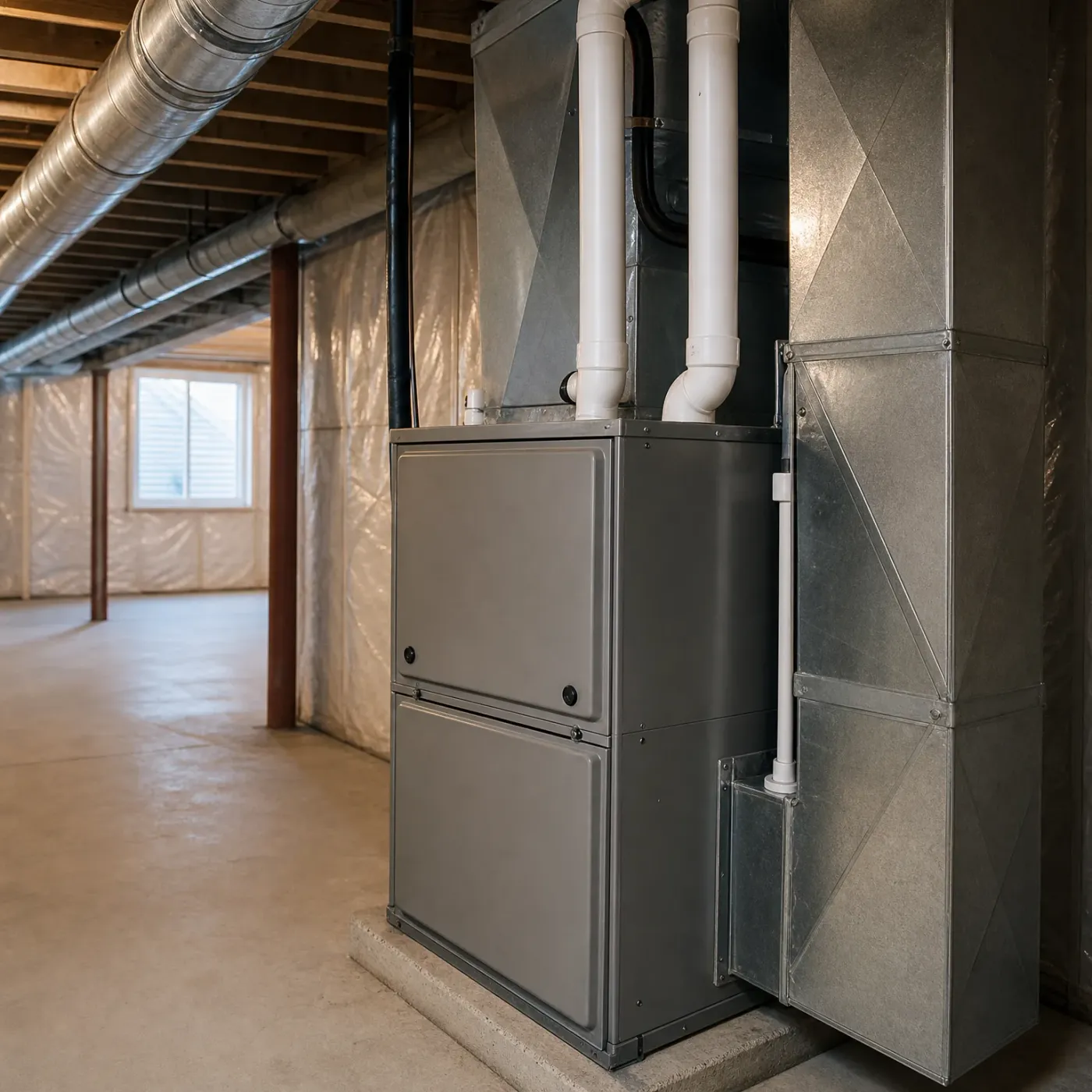
A furnace like this is doing its job: pulling return air through the ductwork, venting exhaust out the flue, and keeping gas and condensate lines sealed and dry.
Rust on the cabinet and corrosion along the piping are signs the unit has been fighting moisture for years, and a furnace in this shape is more likely to fail on the coldest night.
How an Electric Furnace Starts
The thermostat calls for heat first, sending a low-voltage signal to the control board before anything else moves.
On an electric furnace, the control board energizes the heat strips in stages, not all at once, to avoid overloading the circuit.
A sequencer or relay has to close before each stage of strips gets power, and a stuck one leaves the blower running with no heat.
The blower motor won't start until the board confirms the strips are drawing current, so a silent blower often points upstream of the fan itself.
A limit switch near the heat strips shuts the whole system down if airflow is restricted, which is why a dirty filter can stop a furnace cold.
Some control boards flash a code through an LED when they lock out, and that code tells a technician where to start before the panel is even opened.
An electric furnace doesn't just flip on and send heat through the house. It starts with a call from the thermostat, a low-voltage signal that tells the control board someone wants the house warmer. The board is the one making decisions from there. It brings the heat strips on in stages, one at a time, because pulling that much current all at once would trip the breaker you just checked. Each stage has to pass through a sequencer or a relay first, and if one of those sticks, you can end up with a blower that runs fine but no heat ever reaches the vents. That's worth knowing if you've been standing by a vent feeling only room-temperature air moving. The blower itself waits on the board too. It won't spin up until the board sees the strips drawing power, so a blower that stays silent often means the problem is upstream, not in the fan motor. Near the strips sits a limit switch, and its job is to shut the whole system down if airflow gets restricted. That's the direct link between a dirty filter and a furnace that won't run at all. When something trips this chain, a lot of control boards flash a code through a small LED. It won't mean much to you, but it tells a technician where in that sequence things stopped before they ever open the panel.
A pro who works on furnaces
Send the request today and stop worrying about who to call.
Get matched with a pro who works on furnaces in White County.
A furnace like this starts when it's told to, moves air through the ductwork without strain, and pushes exhaust out through the PVC pipe steadily. The gas line stays sealed, the condensate drains clear, and the cabinet stays dry.
Signs it's struggling
The flexible conduit feeding this unit is a common spot for a loose or chewed wire, which can cut power before it reaches the control board. If the condensate line backs up or freezes, some furnaces shut themselves down rather than run.
Winter nights average 33°F
At 33°F overnight, a furnace isn't warming a house that's merely cool, it's fighting real cold for hours at a stretch. If the heat strips or igniter aren't firing right, that's the gap between a warm house and a cold one by morning.
NOAA nClimDiv 1991-2020
Working as it should
A furnace like this vents exhaust cleanly through its PVC piping and keeps the plenum sealed tight. Air moves through the ductwork without strain, and the intake and exhaust pipes stay clear. No rust, no scorching, no loose connections at the cabinet.
Signs of trouble
This older furnace vents through a flexible metal flue into the block wall instead of PVC, and that connection can loosen or rust over time. If the flue pipe has come loose, worked itself out of the vent opening, or shows rust at the seams, the furnace may shut itself down rather than run unsafely.
Before you get your furnace repairAfter you get your furnace repair
1
Thermostat sends a call for heat to the control board.
2
Control board checks the limit switch and safety circuits first.
3
Inducer motor starts to pull air through the heat exchanger.
4
Pressure switch confirms draft before power reaches the igniter or valve.
A furnace that won't start has a reason, and it's findable
A breaker that tripped, a sequencer that failed, a pressure switch that won't confirm draft. Whatever it turns out to be, it's a specific part doing something specific, not a mystery. That's the part worth holding onto on a cold night in Searcy when the house is getting colder and the furnace just sits there.
Once you send the request, you're not the one who has to track down a contractor or figure out who's available tonight. A contractor who covers White County gets matched to what you described and reaches out to you directly. You've already done the hard part by checking the breaker and the thermostat. The rest is someone else's job now.
Furnace Repair
Get your furnace to the right pro
Say what's going on with your furnace, and a pro who works on them reaches out.
Your request goes to a White County pro who takes furnace jobs.
After this form, you can stop searching for a furnace pro.
One request and the search for a pro is handled.
Fill out one short form instead of calling around.
Explain the job once and skip repeating it on every call.
A licensed pro who works in White County gets your request.