




Single-story buildings with pale siding and one brick section with a covered porch stand behind a trimmed hedge and lawn, under a large moss-draped oak branch.

Heat Pump Installation in Batesville, AR

Tell us about the job

Takes about a minute. No obligation.

New system or replacementHeat PumpIndependence County, AR
Step 1 of 2

What ZIP code is the job in?

Electricity heats 55.8% of homes in Independence County, more than any other fuel, and a heat pump fits right into that setup. There's no gas line to deal with and nothing to convert. Utility gas heats 26.2% of homes here, and bottled or LP gas heats another 13.1%, but electric is still what most homes already have. If your place is one of them, swapping in a heat pump means working with wiring already there for electric heat, not retrofitting around a furnace built for something else.

7 months
October through April, your system heats
5 months
May through September, it cools
31°F
the average winter night it heats against
89°F
the average summer afternoon it cools against
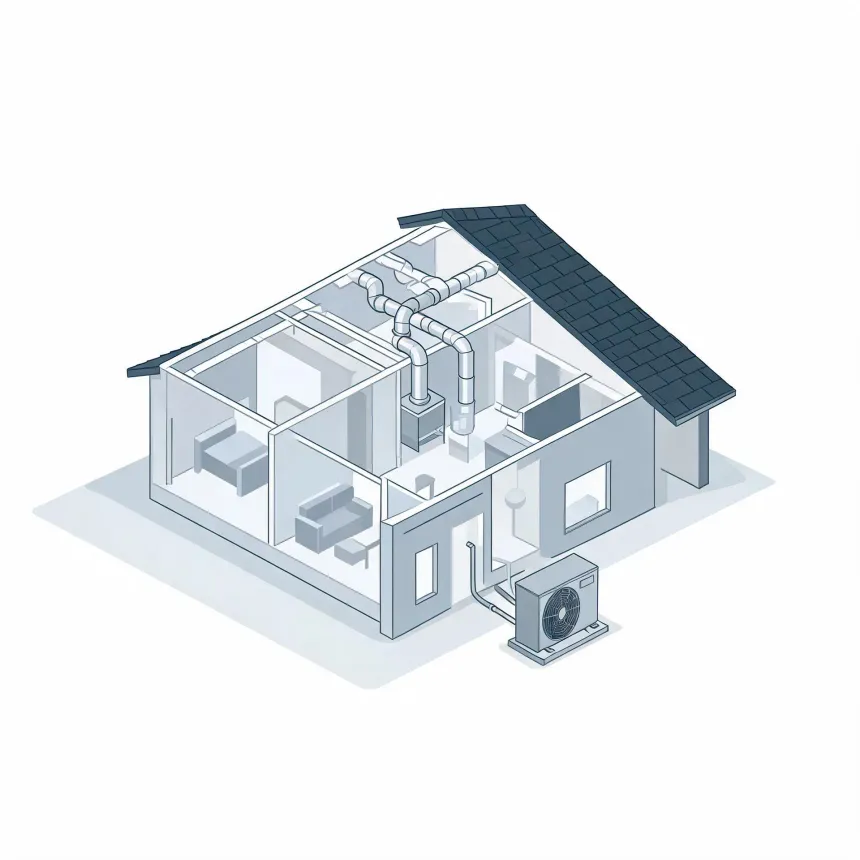
Isometric line illustration of a cutaway house showing interior rooms with furniture, ceiling ductwork connected to an indoor air handler, and an outdoor condenser unit linked by refrigerant lines.
Your system heats October through April and cools May through September.

NOAA nClimDiv, 1991–2020 normals

Arkansas electricity runs about 12.32 cents per kilowatt-hour, below the national average.

A heat pump still beats electric resistance heat here, but the payback on paying extra for the highest efficiency model stretches out, so pick one for reliability and fit first.

Batesville sees its share of wind and storms, but a standard heat pump handles it the same as anywhere else

66 severe weather events from 2015 to 2024
24% of homes statewide lost power a day or more in 2024
32 damaging wind events from 2015 to 2024

A heat pump here runs most of the year, heating October through April and cooling May through September. That leaves April and September as the two stretches where it isn't carrying much load, and those are the months worth planning an install around. Put it in during April and it gets a full month to settle in before the summer heat shows up. September works the same way ahead of the heating months. Wait until the system you have now fails in the middle of winter or summer, and you're taking whatever unit a contractor can get installed fast, not the one sized right for your house.

A heat pump in Batesville has a regional efficiency floor to clear

Any heat pump installed here now has to clear 14.3 SEER2 for cooling and 7.5 HSPF2 for heating, and the SEER2 minimum runs higher across the Southeast than it does nationally. That narrows the field before you even start comparing units, so you're choosing among systems that already clear this region's bar. A federal tax credit is available on top of that.

Find a contractor
A man in a cap, navy long-sleeve shirt and tan work pants carries a canvas tool bag up steps toward a dark front door, with a potted shrub beside the porch.
A white mini-split heat pump outdoor unit mounted on a concrete pad beside a gray-sided house, surrounded by gravel and green shrubs.

The question that matters more than the efficiency rating

Ask how the contractor is sizing the unit. It should come from a load calculation on your house, not a copy of whatever tonnage is already out there. A unit that's too big cycles on and off instead of running long steady stretches, and that short cycling wears on the compressor over time. A unit that's too small runs almost constantly and still falls behind on the coldest days. Ask what happens when it's cold enough that the heat pump can't keep up on its own. Some systems lean on backup heat strips to cover the gap, others lean harder on the compressor itself, and the difference shows up on the electric bill and in how warm the house actually feels. Ask about the compressor warranty separately from the parts warranty, since they often run different lengths, and ask whether it's the manufacturer or the installing contractor who stands behind it if something fails.

What happens to the furnace or AC coming out

A working furnace or AC that gets pulled during a heat pump install usually gets recovered for the refrigerant, then scrapped. The metal has some salvage value, but the unit itself doesn't get resold or reused in another house. If the old system shares ductwork or a plenum with the heat pump going in, the contractor has to disconnect it cleanly before the new equipment ties in.
What stays and what doesn't

If there's a gas furnace involved, the gas line to it needs to be capped off, not just left connected with the furnace gone. Any electrical whip or disconnect that fed the old outdoor unit either gets reused for the new one or replaced if the amperage doesn't match. The old thermostat almost always comes out too, since a heat pump needs one built to run the compressor and backup heat on different stages.

Sizing a heat pump starts with a room by room heat loss and heat gain calculation, not the size of the unit already sitting outside. That calculation looks at window area, insulation, ceiling height, and how much wall faces each direction, then adds it into a number the equipment has to match. Square footage alone never gets you there, since houses built differently need different tonnage even at the same size. Get the load calculation right and the compressor runs long, steady cycles that hold the temperature even and pull moisture out of the air properly. Get it wrong in either direction and the system either sits idle most of the time or struggles to keep pace once the temperature swings hard.

The outdoor unit comes out first, unbolted and disconnected from its pad. Indoors, the air handler or coil gets swapped, and the refrigerant lines get run new or reused depending on their condition. Once the new equipment is set, those lines get pressure tested and pulled into a vacuum to clear out moisture and air, since either one left behind damages the compressor over time. Electrical connections get tied in last. Then the contractor runs the system through both heating and cooling to check the temperature split at the vents and confirm the thermostat is staging the compressor and backup heat correctly. Ask to see those numbers at the walk through, not just hear that everything checks out.