







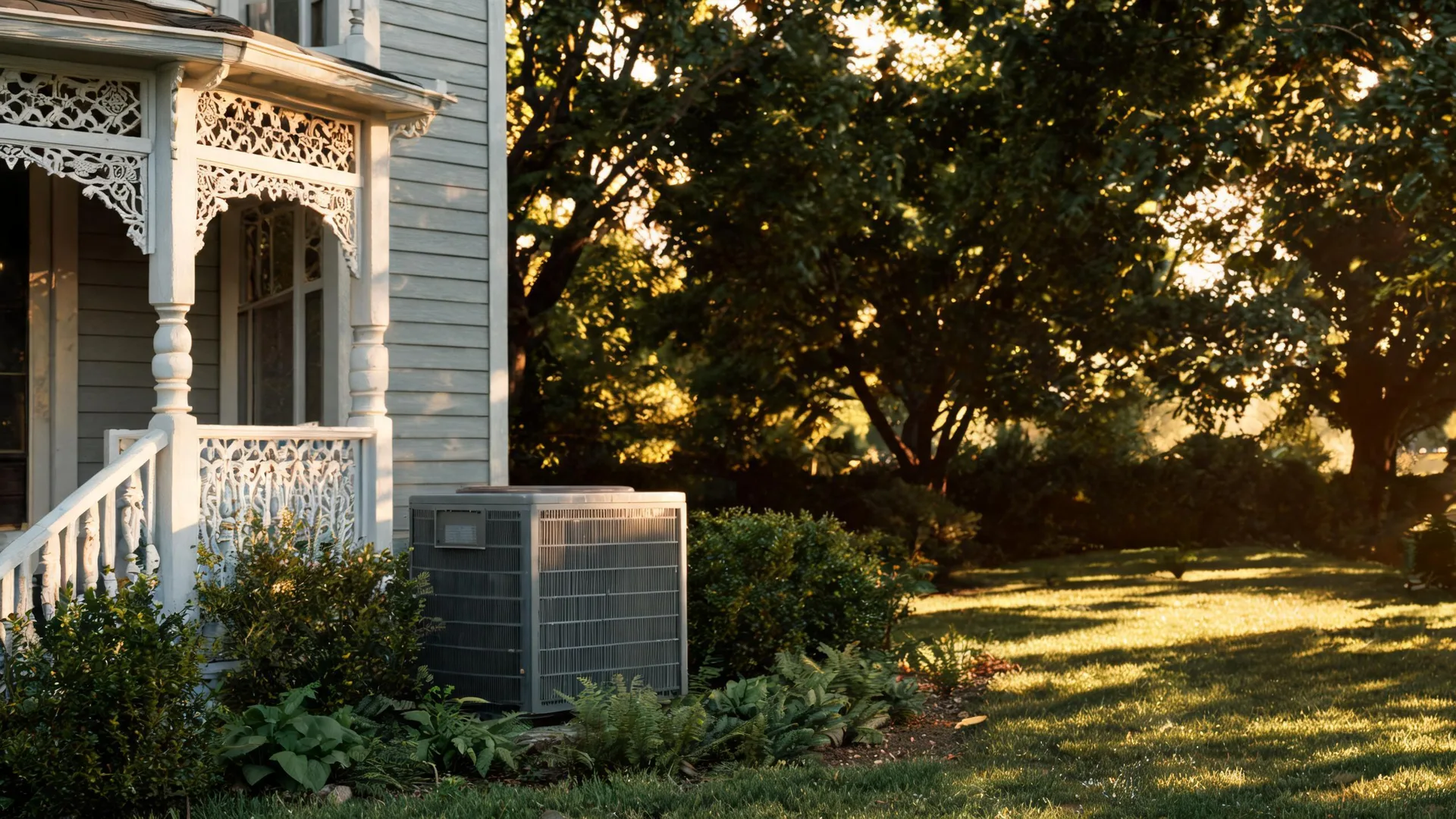
A grey residential air-conditioning condenser unit mounted on a concrete pad beside a house, photographed at sunset.

Heat Pump Installation in Malvern, AR

Tell us about the job

Takes about a minute. No obligation.

New system or replacementHeat PumpHot Spring County, AR
Step 1 of 2

What ZIP code is the job in?

Electricity heats 58.2% of homes in Hot Spring County, more than gas and propane combined. A heat pump fits right into that setup since it runs on electricity already. Gas still heats about 3 in 10 homes here, and propane a smaller share on top of that. If your house already runs on electric heat, going to a heat pump means the wiring and setup are already there to work with. That's the simplest path, and it's the one most homes here are already on.

5 months
November through March, your system heats
5 months
May through September, it cools
33°F
the average winter night it heats against
91°F
the average summer afternoon it cools against
Isometric cutaway illustration of a single-story house showing interior ductwork, an indoor air handler and furnace unit, and an outdoor condenser connected by a line, on a white background.
Your system heats November through March and cools May through September.

NOAA nClimDiv, 1991–2020 normals

Half the homes in Hot Spring County were built in 1979 or earlier, half in 1979 or later.

A heat pump sized to your square footage works the same in either one.

Cheap power here means payback takes longer, so pick the heat pump that will hold up

Power costs 12.32 cents a kWh statewide
Climate zone 3A
Cooling runs May through September
Weather here is normal, and so is the fix83 severe weather events hit this county between 2015 and 2024. A standard install holds up fine.

October is worth marking on the calendar. Heat here doesn't start until November, so a heat pump going in during October gets a full month of mild weather before it has to do any work. That gives it time to get commissioned properly and gives you time to notice if something sounds off before you're relying on it on a cold morning. Wait until the first cold snap and you're choosing between living without heat for a few days or rushing the installers through it. Homes here run heat for about five months, November through March, so getting the start of that stretch right matters more than people expect.

Any heat pump going in has to clear 14.3 SEER2

Zone 3A sets the floor here. Any split-system heat pump made since January 2023 has to hit 14.3 SEER2 for cooling and 7.5 HSPF2 for heating. That's not an upgrade option, it's the minimum a contractor can sell you. A federal tax credit is available on top of whatever you're quoted.

Find a contractor
A man in a navy T-shirt, tan work pants and cap, seen from behind, carries a worn canvas tool bag up wooden porch steps toward a dark blue front door.
A gray heat pump condenser unit mounted on a concrete pad against the gray lap-siding exterior wall of a house.

This one runs all year, so ask how it holds up over the long haul

A heat pump runs every day of the year, not just in the cold months. It switches over to cooling once the weather turns and keeps going straight through, so the compressor gets far more hours on it than a furnace or an AC unit ever would alone. When you're comparing systems, ask what happens at the coldest end of the range, the point where the unit has to work hardest to pull heat out of cold air. Ask whether it has a secondary heat source built in for those stretches, and how it decides when to use it. Ask about the compressor type too. A variable-speed compressor adjusts its output to match what the house needs and tends to spend less time cycling on and off, which matters over years of near-constant running. A single-speed unit just runs full blast or not at all. Also ask what the defrost cycle looks like, since the outdoor coil will frost up in cold, damp weather and the system needs a reliable way to clear it without dumping cold air inside while it does.

The rating is a lab average, not a promise

SEER2 and HSPF2 come from testing the unit across a set range of conditions, then averaging the result into one number on the label. Your house is not the lab. Ductwork, how well the place holds temperature, and where the outdoor unit sits all push real performance up or down from that number. A heat pump with the same rating can perform differently from one house to the next.
A higher rating costs more up front to save later

A heat pump with a higher SEER2 or HSPF2 number almost always costs more to buy than one sitting at the minimum allowed. The payoff comes afterward, in lower electricity use to move the same amount of heat. Whether that tradeoff is worth it depends on how long you plan to keep the system and how hard it runs over the year.

Sizing is the part that decides whether any of the rest works. A heat pump that's too big cools the air fast, shuts off, and leaves the place clammy, because it never runs long enough to pull the moisture out of the air. One that's too small runs flat out on the coldest and hottest days and still can't keep up, leaning on the backup heat strip more than it should. Getting the size right starts with a load calculation. That looks at the square footage, sure, but also the windows, the insulation, the ceiling height, and how much sun the walls get through the day. It's a room-by-room count of how much heat the house actually loses and gains, not a chart that matches tonnage to floor space.

The old equipment doesn't just get unplugged and left there. If it's a furnace paired with the outdoor unit, the gas line gets capped off properly, not just shut at the valve. The refrigerant in the old system has to be recovered into a tank rather than vented, since releasing it into the air is against the law. The indoor coil and the old line set usually come out too, especially if the new lines run a different size or route. Whatever's left gets hauled off. None of it gets left in the yard or the basement for you to deal with.