May and November are when it breaks
A heat pump sits idle for months, then gets asked to cool the house starting in May or heat it starting in November. If a part was already weak, that first week of real load is when it gives out.
Takes about a minute. No obligation.
A heat pump sits idle for months, then gets asked to cool the house starting in May or heat it starting in November. If a part was already weak, that first week of real load is when it gives out.
Heat runs in Camden from November through March, so October is the last easy window to deal with a problem before the system has to hold heat for the next five months. Waiting until a cold morning in November means doing the repair while you also need the heat working.
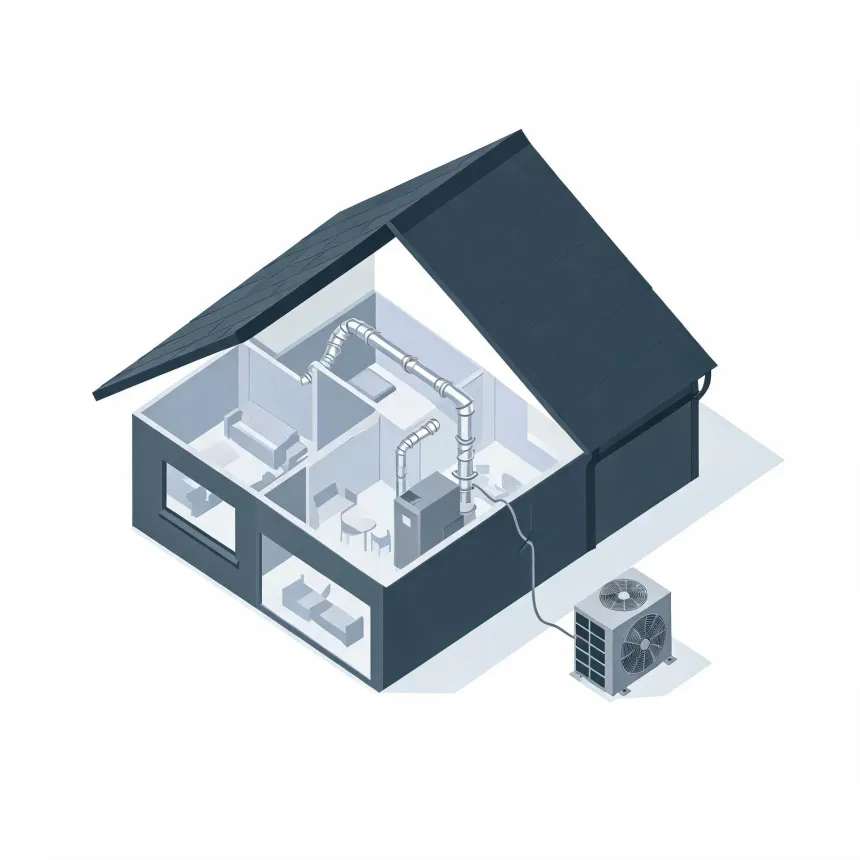
NOAA nClimDiv, 1991–2020 normals
A heat pump that's low on refrigerant will keep running, but the compressor works harder to move the heat.
Run it like that through a full winter and you're looking at a compressor replacement instead of a refrigerant check.

A heat pump fails for a short list of reasons, and most of them show up slowly before they show up all at once. The reversing valve is a common one. It's what switches the system between heating and cooling, and when it sticks, the unit keeps running but stops doing what you asked it to do. The defrost control board is another. It's supposed to clear frost off the outdoor coil in winter, and when it fails, ice just builds up on the coil until the system can't pull heat from the air anymore. Capacitors weaken over time and eventually stop giving the compressor or fan motor the jolt it needs to start. Low refrigerant is almost always a sign of a leak somewhere in the line set, not a fluid that just runs low on its own. Most of these start as a system that runs longer than it used to, or blows air that isn't quite the right temperature, well before it quits outright.
Problems tend to show up in the first weeks of the season, when the load hits a part that was already weak.
Find a contractorBefore anyone comes out, there are a few things worth checking yourself. Go outside and look at the outdoor unit. If the coil is caked in ice or snow, that's worth noting, especially if it's not defrosting on its own over the course of a few hours. Check that nothing is blocking airflow around it, no leaves, no fence line too close, nothing piled against the sides. Inside, check your thermostat batteries if it uses them, and make sure it's actually set to heat or cool and not sitting in a mode you didn't mean to pick. Pull the air filter and hold it up to a light. If you can't see light through it, that's your problem or at least part of it, and it's one you can fix yourself in a few minutes. Walk around the house and feel the vents. If some rooms get airflow and others don't, that tells a tech something useful before they even arrive. Listen to the unit too. Banging, squealing, or a hard click that repeats without the system starting are all things worth describing when you call, because they point toward different parts.
A heat pump that shuts off a couple minutes after starting is usually tripping a safety switch, not just being quirky. A pressure switch, a limit switch, or an overheating compressor can all cause this. Each short cycle puts a hard start on the compressor, so a unit doing this all day is aging fast even while it's technically running.
A burning smell from the vents when the system first kicks on can mean dust burning off a heat strip, but if it lingers it's worth shutting the system off and calling someone. A musty smell usually points to standing water in the drain pan or a clogged condensate line. Grinding or squealing from the outdoor unit usually means a motor bearing is going, and it won't fix itself by waiting.
There's no fixed rule for when a heat pump is done, but a few things push the decision one way or the other. If the compressor itself has failed, that's usually the point where repair stops making sense, since it's the most expensive part in the system and the labor to replace it isn't far off from a new unit. If it's the second or third repair in a couple years, that pattern matters more than any single part does, because a system that keeps finding new ways to fail is telling you something about its overall condition. Age matters too, not as a hard cutoff but because older units use a refrigerant or parts that are harder to source, so a simple fix can turn into a long wait. A reversing valve or a capacitor is worth replacing on a system that's otherwise sound. A failed compressor on a system that's already needed other work is a different conversation.