Single-story brick and white-sided houses behind a trimmed hedge and lawn, framed by overhanging oak branches draped with Spanish moss under an overcast sky.

Heat Pump Repair in Fort Smith, AR

Tell us about the job

Takes about a minute. No obligation.

RepairHeat PumpSebastian County, AR
Step 1 of 2

What ZIP code is the job in?

Check the thermostat and the breaker first

Make sure the thermostat is set to heat or cool and not sitting in some scheduled mode you forgot about. Then check the breaker panel for the outdoor unit and the air handler. A tripped breaker or a thermostat bumped into the wrong setting looks exactly like a failed heat pump.


Look at the outdoor unit and the filter before you call

Walk outside and see if the coil is covered in ice, if the fan is spinning, and if anything is blocking airflow around the unit. Then pull the filter and hold it up to the light. A choked filter starves the system and can cause the same symptoms as a bigger failure, so clearing it first tells the contractor what they're actually dealing with.

6 months
November through April, your system heats
5 months
May through September, it cools
31°F
the average winter night it heats against
91°F
the average summer afternoon it cools against
Isometric line illustration of a cutaway single-story building showing interior rooms, ceiling ductwork, an indoor air handler, and an outdoor condenser unit connected by refrigerant lines.
Your system heats November through April and cools May through September.

NOAA nClimDiv, 1991–2020 normals

Half the homes in Sebastian County were built in 1981 or later.

A heat pump that came with a newer house still has working life left in it, so repair is usually worth it.

Fort Smith weather puts heat pumps to work

122 damaging wind events from 2015 to 2024
61 hail events from 2015 to 2024
Power costs 12.32 cents a kWh statewide

Heat pumps in Sebastian County switch over in November, and that first cold snap is when a weak part finally gets found out. A heat pump that coasted through October on light use suddenly has to run long cycles to hold the house at temperature, and that's when a tired capacitor or a low charge shows up as a system that runs but won't keep up. The same thing happens in reverse come May, when the first hot stretch asks for steady cooling after months of doing nothing. If your heat pump is acting up right at the start of one of these runs, that timing is a clue worth telling the contractor about.

Repair it

If your system came with a newer house, it likely has plenty of life left. Repair is usually the right call.

Find a contractor
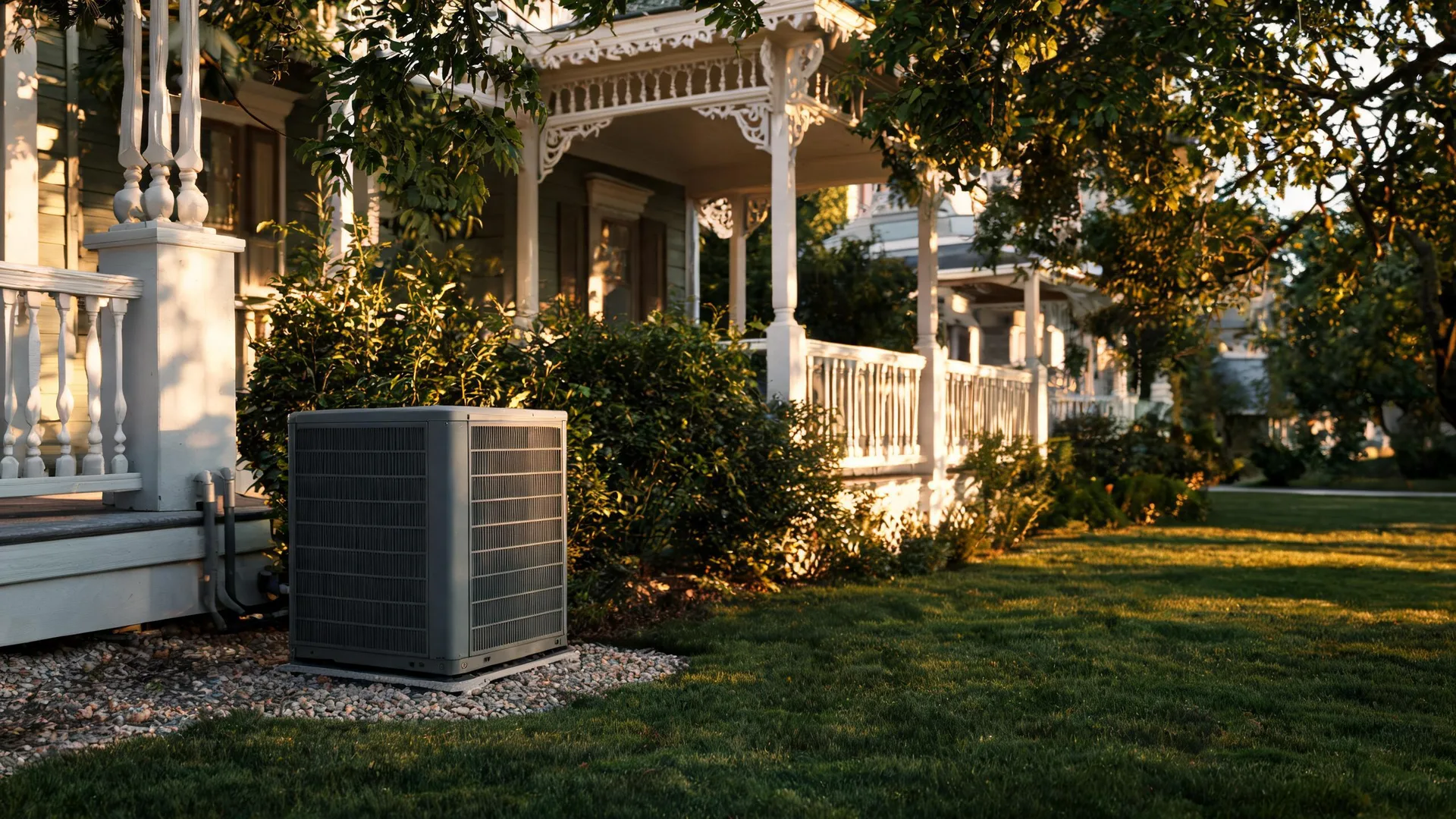
A gray heat pump outdoor unit mounted on a concrete pad next to the stone-accented exterior wall of a house.

Why running it longer can turn a small problem into a bigger one

A heat pump that is struggling still tries to do what the thermostat asks. The compressor keeps starting, the fan keeps turning, and whatever is wrong gets asked to work anyway. A capacitor that is almost gone wears out fast under that kind of repeated strain. A compressor running low on charge overheats trying to make up for it, and heat is what kills a compressor over time. Ice on the outdoor coil is another one. A little frost that would melt off during a normal defrost cycle turns into a solid block if the system keeps running instead of shutting down, and that blocks airflow across the coil entirely. None of this means every noise or short cycle is an emergency. But a system that is clearly laboring, not just underperforming, is usually better off switched off at the thermostat until someone looks at it.

The reversing valve is the part unique to a heat pump

The reversing valve switches the system between heating and cooling, and it fails in a particular way. A stuck valve often leaves the system blowing cold air when it should heat, or running constantly without satisfying the thermostat. A standard air conditioner does not have this part, so it is usually the first thing a contractor checks when a heat pump will heat but not cool, or the other way around.

Most other failures are the same ones any AC or furnace has

A weak capacitor struggles to start the compressor or the fan motor, and that gets worse gradually before it fails outright. A low refrigerant charge means a leak somewhere in the line set or coil, not something fixed by just adding more. A dirty outdoor coil blocks airflow and makes the whole system work harder to move heat in or out. These parts wear the same way whether the system only cools or runs both directions.

Most calls start with one of a few things. The system runs but the air coming out doesn't feel like much of anything, hot or cold, which usually points to the reversing valve or a charge that's dropped. Short cycling is another one, where the unit kicks on, runs a few minutes, and shuts off before the house changes temperature at all. That points to a safety switch tripping, often tied to airflow or a part overheating. A heat pump that won't switch from heat to cool, or gets stuck in one mode no matter what the thermostat asks for, is almost always the reversing valve. Ice building up on the outdoor unit when it shouldn't be there, or never clearing on its own, means the defrost cycle isn't doing its job. Any grinding, squealing or banging from the outdoor unit is a motor or compressor problem, and that's not something to wait out.

A diagnostic call starts outside at the unit itself, not with a tool. A contractor watches it run through a full cycle, listens for where the noise is coming from, and checks the readings off the compressor and the lines before touching anything. Refrigerant charge gets checked with gauges, since a system can look fine and still be low. Electrical parts get tested with a meter rather than guessed at, because a capacitor or a contactor can look fine and still be the reason the system won't start. If the complaint is about heating and cooling being reversed or stuck, the reversing valve gets tested directly rather than assumed. The point of all this is to find the one part that's actually failed, instead of replacing things until something works.