
How long a furnace lasts in Benton, AR

After you send the request, you're done searching.

Hand off my installation

How long does a furnace last in Benton, AR?

You've had the same furnace for a while now and you're starting to wonder if it's on borrowed time, especially with how cold it gets around Benton in the winter. Maybe it's making a new noise, or maybe you just want to know what to expect before it fails on you in January. Either way, you want a straight number, not a guess.

A furnace in Benton typically lasts 15 to 20 years.

Most homes in and around Saline County heat with electricity, and an electric furnace tends to hold up well because it has fewer moving parts to wear out than a gas unit does. Winters here are cold enough that the furnace runs hard for months at a stretch, and that steady use over the years is what eventually wears down the heat strip and blower motor. Once a furnace passes the 15 year mark, it's worth having someone look at it before the coldest part of winter arrives, rather than after it stops working on a night you need it most.

A dimly lit interior with wood plank flooring where a small portable heater with a glowing orange element sits near an open doorway, with a stove at left, kitchen cabinets and a potted plant at right, and a wooden table and chair in the foreground.

The space heater is the only thing making noise this morning, that low electric hum next to the table. You've got the basement door propped open because that's where the furnace is, and you went down twice already, first to check the pilot, then just to stand near the vents and feel for warm air that isn't coming. Outside it's still dark, that kind of late-winter cold Saline County gets right before it breaks. Your coffee's gone lukewarm because you keep walking back to the basement door to listen. The heater throws enough heat to keep the kitchen bearable, but you can see your breath a little in the hallway, and you're doing the math on how many more mornings you can do this before you call someone.

What Benton winters actually ask of your furnace

  • Winter nights average 33°F

    Overnight lows average 33°F through December, January and February in Saline County, so your furnace is cycling on most nights, not just the cold snaps.

  • Heat runs November through March

    Heat runs November through March here, about five months. That's five months your furnace has to start up and work without a break in the schedule.

  • 56.6% of homes heat with electricity

    56.6% of homes in Saline County heat with electricity, more than any other fuel, so most furnaces around you are electric and wear the same way yours does.

NOAA nClimDiv 1991-2020 · ACS 2020-2024

Keep patching it along

If the furnace is still heating the house evenly and the repairs haven't started stacking up, there's a case for riding it out another winter. A cracked heat exchanger or a cycling limit switch changes that math fast, but short of a real problem, a furnace that's doing its job doesn't need to be replaced on a calendar. You'll spend a little on service calls here and there. You'll keep an eye on the gas or electric bill. Saline County winters aren't brutal, so an older furnace that's otherwise sound can usually get through November to March without much drama.


Get ahead of it now

If you're already thinking about this, something's nagging at you, maybe a smell, a noise, a room that stays cold. Waiting means betting that it holds on through the next cold snap, and if it doesn't, you're calling someone in January with no heat and no time to compare options. Replacing it before it fails means you pick the unit, pick the week, and aren't stuck taking whatever's available on short notice. A local contractor who works on these year-round can tell you in one visit whether you're looking at another winter or not.

A man in a gray sweater reclines in a brown leather armchair with his eyes closed, beside a wooden side table holding a mug, a folded newspaper and a potted plant, with a bookshelf and sunlit window behind him.
A man with greying hair and a dark sweater leans back on an armchair with his eyes closed and a slight smile, in a living room with a bookshelf, plant, folded newspaper and mug on a wooden table.
A man in a gray fleece jacket sits reclined in a leather chair with his eyes closed, in a room with bookshelves, a table lamp, a window, and a desk holding a folded newspaper and a dark mug.
A bearded man in a gray fleece pullover sits with eyes closed in a brown leather armchair in a living room, with a floor lamp, bookshelf, potted plants, a side table holding newspapers and a dark mug, and a bright window behind him.

Why electric furnaces hold up here

Most homes in and around Benton heat with electricity, and an electric furnace has fewer ways to fail than a gas one. There's no igniter, no flame sensor, no burner assembly to foul up. What wears out is the heating element, the blower motor and the bearings that keep it spinning. Power here is cheap enough that running electric heat all winter doesn't strain a budget the way it does in places where people ration their furnace use. That matters for how a furnace gets treated over its life. A furnace that isn't babied along, that gets run whenever the house is cold instead of switched off to save money, actually cycles more evenly and stresses the blower less than one that's constantly stopped and restarted.

What actually ends a furnace's life

It's rarely one dramatic failure. The blower motor bearings wear down after enough winters of running five months straight, and at some point the motor starts drawing more than it should or seizing on cold mornings. The heating element can crack from years of expanding and contracting every time it cycles on. Once the cabinet or the ductwork around it starts rusting from basement humidity, a repair stops making sense even if the parts are cheap, because the next failure is never far behind. A furnace that's needed two separate repairs in the same winter is telling you something about where it stands, regardless of what the thermometer on it says.

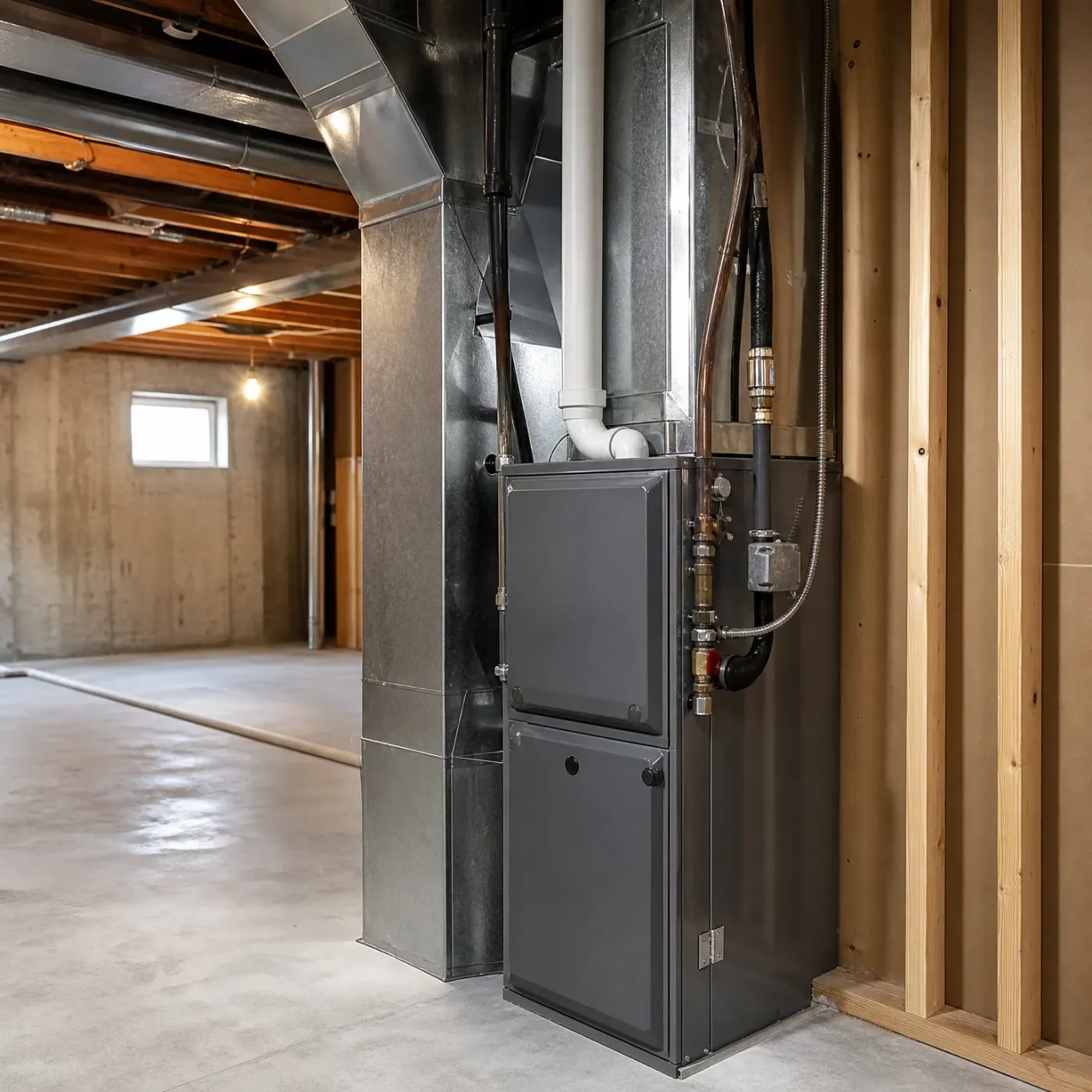
A gray metal furnace with two white PVC vent pipes stands on a concrete floor beside galvanized sheet-metal ductwork in a basement or utility space with wood framing.
Before you get your furnace installation
A gray furnace cabinet in a basement with sheet-metal ductwork, white PVC vent pipes, and black gas piping against a concrete wall and wood-framed partition on a bare concrete floor.
After you get your furnace installation
A gray furnace with copper and flexible piping stands against a wood-framed wall in an unfinished basement, connected to galvanized sheet-metal ductwork and PVC venting, with a concrete floor and exposed joists.

Done looking for a furnace pro

The pro who gets in touch is licensed in Arkansas and works in Saline County.

Send the form and the search for an installer is over.

Reach a local pro

You only hire the pro if you want to.

A beige high-efficiency furnace stands on a concrete basement floor beside sheet-metal ductwork, with white PVC vent pipes and a gas line running along an insulated wood-framed wall.
A furnace like this, with clean flue pipes and a dry floor underneath, is heating the house the way it was built to.
An older metal furnace with a louvered front panel stands against a concrete basement wall, connected to sheet-metal ductwork and a flue pipe, with copper and steel pipes running alongside.
A furnace left to collect dust like this is further along than it looks, and the louvered panel won't tell you how far.

A furnace rarely dies on one bad morning. It wears down in order. The heating element takes the most punishment, since it cycles every time the thermostat calls for heat, so it's usually the first thing to go. Next the blower motor starts working harder to turn the wheel, drawing more power even while the air coming out still feels fine to your hand. Limit switches are supposed to catch trouble before it spreads, so a furnace that trips one often has an airflow problem building somewhere ahead of it, maybe a dirty filter, maybe something worse. By the time you see rust or scorch marks around the cabinet seams, the parts behind that panel have already been running hotter than they're built for. Short-cycling, where the furnace fires up and shuts off in quick bursts, is usually the last sign before a bigger failure, the furnace trying to compensate for a part that's no longer keeping pace. None of this shows up overnight. It shows up in pieces, and each piece is a clue to how much longer the rest of it has.

How a furnace actually quits

  • A furnace doesn't fail all at once, it loses pieces of itself one at a time until the last one gives out.
  • The heating element is usually first, since it cycles on and off every time the thermostat calls for warmth.
  • A blower motor that strains to turn the wheel is pulling more amps than it used to, even if the air still feels warm.
  • Limit switches are built to shut the furnace down if airflow drops, so a unit that trips often is telling you something upstream is already wrong.
  • Rust or scorch marks near the cabinet seams usually show up after the parts inside have already been running hotter than they should.
  • A furnace that short-cycles, turning on and off in quick bursts, is usually fighting a part that can't keep up anymore.
A gray-haired man with a beard in a blue button-placket shirt reclines on a couch with his eyes closed, beside a sunlit window with a green plant.
A woman in a cream knit sweater sits in an armchair with her eyes closed near a window showing yellow autumn foliage, with a mug on a round wooden side table beside her.
  1. Thermostat calls for heat and signals the control board.

  2. Blower motor starts pulling air across the heating element.

  3. Heating element heats up and warms the moving air.

  4. Warm air pushes through the ducts into each room.

Is your furnace trying to tell you something?

A furnace on its way out gets loud before it quits. Listen for a bang when it first kicks on, or a rattle from the blower that wasn't there last winter. Some rooms might run colder than others now, or the air coming out of the vents feels lukewarm instead of warm. You might notice the smell of dust burning off the first few times it runs, and that's normal, but a burning smell that doesn't go away isn't. If the unit short cycles, shutting off a few minutes after it starts, that's the limit switch protecting itself from overheating. Left alone, a furnace in this shape either stops heating the house on a cold night or costs more every month to do less.

A gas furnace with two gray access panels stands against a plain wall in a basement, connected to sheet-metal ductwork, white PVC vent pipes, and a yellow gas line.

Waiting on a repair call

A technician comes out, looks at the heating element or the blower motor, and quotes a repair. That buys you a few weeks of warmth, but it doesn't tell you what's next in line to go. You're back to watching the furnace, waiting for the next noise, the next cold room, the next call. Saline County winters don't leave much room for that kind of guessing, especially once nights are regularly in the 30s.

A gray high-efficiency furnace in a basement corner with white PVC vent pipes, copper and black gas piping, and sheet-metal ductwork beside a plain white wall and wooden stair framing.

Getting it replaced instead

A new furnace sized right for your house heats evenly from the first cold night through the last one in March. No patched-together parts, no guessing which component is next. A contractor who installs these every winter in and around Benton knows what usually fails first in homes here and sizes the replacement so it isn't working harder than it has to, winter after winter.

Winter nights average 33°F

33°F is the average overnight low, not the coldest it gets. Your furnace is working through most nights of the winter, not just the hard freezes, which is why a unit already struggling tends to show it early in the season rather than waiting for January.

NOAA nClimDiv 1991-2020

A gray high-efficiency furnace with white PVC vent pipes stands on a concrete pad in a basement, beside sheet-metal ductwork, copper piping and a poured concrete wall with wood framing at left.

Running the way it should

The flue pipes stay clean and the floor underneath stays dry. Gas lines and condensate pipes are tight with no corrosion forming where they meet the furnace. Ductwork overhead is holding the seal, pushing warm air through the house without the furnace straining to keep up.

A beige gas furnace in a basement with a metal flue pipe, galvanized sheet-metal ductwork to its left, and gas and water pipes along the concrete wall to its right.

Already losing ground

An older unit like this has had years of cycling to work against it. Flue pipe routed straight up is normal, but check for rust streaking down it or soot around the draft hood. Shutoff valves nearby are worth a look too, since a slow leak at an old fitting won't announce itself.

A furnace around Benton lasts as long as its parts let it, and once the heating element or the blower motor starts going, no amount of patching gets back the years you've already had out of it. Most winters here run cold enough, night after night, that a furnace on its last legs won't make it quietly to spring. When it's time to replace it, you'll be matched with a licensed contractor local to Saline County, the kind who's in and out of these electric furnaces every winter and knows which part tends to go first on a unit your age. You won't get a handful of companies calling to pitch you. Just one, already familiar with what Benton homes run and what they need. That's where you stand now: a furnace that's told you what it's going to tell you, and a straightforward way to get the next one in before the cold asks more of it than it can give.

A gray high-efficiency furnace with two access panels stands on a concrete basement floor, connected to sheet-metal ductwork and white PVC vent pipes, with wood framing and a gas line nearby.

It's off your list after this

New system or replacementFurnace or heatingSaline County, AR
Step 1 of 2

What ZIP code is the job in?