
Furnace keeps shutting off in Cabot, AR

RepairFurnace or heatingLonoke County, AR
Step 1 of 2

What ZIP code is the job in?

Why does my furnace keep shutting off in Cabot?

A furnace that shuts off and on, or quits partway through a cycle, usually means something is telling it to stop. It might run for a few minutes, cut off, then kick back on later, or it might stay off until you reset the thermostat. In Cabot, with electric furnaces running hard through the cold months, this kind of short cycling has a short list of usual causes, and most of them trace back to heat building up somewhere it shouldn't.

A safety switch is cutting power before the furnace overheats

Furnaces have a limit switch that shuts the unit down if the air inside the cabinet gets too hot. A clogged filter, a blocked vent, or a blower that isn't moving enough air all cause that same heat buildup, and the switch does its job by cutting the furnace off. With Lonoke County winters running cold and electric furnaces working long hours to keep up, a furnace that's already straining is more likely to trip that switch. A failing blower motor or a cracked heat exchanger can cause the same shutoffs. Either way, the furnace is protecting itself from damage, not malfunctioning on its own, and the part behind it needs a look before it's left to keep cutting off.

A beige high-efficiency furnace in an unfinished basement, with white PVC vent pipes, a yellow gas line, metal ductwork, and exposed wood framing on a concrete floor.

Running a full cycle

This is a furnace heating the way it should, most homes around Cabot run electric heat, but if yours runs on gas, the burners stay lit until the thermostat is satisfied, then shut off on their own. No short cycling, no cutting out early, just warm air until the house reaches temperature.


An older beige furnace with two louvered vent panels stands on a concrete basement floor, connected to galvanized ductwork and a metal flue pipe, with gas piping and flexible conduit on the wall behind.

Shutting off early

This is an older unit with a flame sensor, limit switch, or pressure switch cutting the cycle short. The furnace fires, runs a few minutes, then stops before the house warms up. On a cold night in Lonoke County, that means rooms that never quite catch up.

Short Cycling vs. Staying Off

Short cycling

  • The furnace fires, runs two or three minutes, then shuts off well before the house warms up.
  • A dirty filter or blocked vent can make the furnace think it's overheating, so it shuts down to protect itself.
  • A cracked heat exchanger or failing flame sensor will cause the same quick on off pattern if your furnace runs on gas.
  • The thermostat cycles the furnace back on within a few minutes since so little heat actually made it into the rooms.
  • Rooms near the furnace get warm while rooms at the far end of the house stay cold, because each cycle is too short to push air through the whole duct run.

Cutting out and staying off

  • The furnace runs for a while, shuts off, and does not come back on even when the house drops below the setpoint.
  • A tripped limit switch or a blower motor that has failed will stop the furnace mid cycle and keep it from restarting.
  • If your furnace runs on gas, a flame sensor coated in residue can shut the gas valve down after only a few seconds of flame.
  • Electric furnace heaters have no pilot or burners, so a dead cycle usually points to a bad sequencer or a tripped breaker instead.
  • You may need to reset the system at the breaker or thermostat just to get any heat at all until the part is replaced.
A woman in a cream sweater with her hair in a bun laughs while seated at a stone counter holding a glass of red wine, in a dimly lit interior with a sofa, houseplants and a large window at night.
A woman with long dark hair in a cream knit sweater laughs while looking off to the side, seated in front of a dimly lit kitchen with an island, stools, open shelving and a potted plant, with a glass of red wine in the foreground.
A smiling woman with long dark wavy hair in a light knit sweater sits at a marble counter with a glass of red wine, with a dimly lit living room and kitchen in the background.
A smiling woman with long wavy brown hair in a beige sweater sits at a white marble counter with a glass of red wine, with a living room, dining table and kitchen cabinets behind her.

What are you noticing when it cuts off

You might hear the burners or the blower stop well before the house feels warm, then the thermostat calls again a few minutes later. Some rooms stay cold while others heat fine. The air coming out of the vents might feel cooler than usual, or you might notice the furnace running almost constantly, cycling on and off through the evening instead of holding steady. If it's been doing this for a while, the furnace is working harder to heat the same space, and that shows up on the electric bill. Left alone, a furnace that keeps tripping off can wear out the parts causing the problem faster, and on the coldest nights it may not keep up at all.

  1. Thermostat calls for heat and sends power to the control board.

  2. Inducer motor starts and pulls air through the heat exchanger.

  3. Pressure switch confirms draft, letting the igniter glow hot.

  4. Gas valve opens and burners light off the igniter.

Why does cold weather make my furnace shut off so often

  • Winter nights average 34°F

    Winter nights here average 34°F, cold enough that a furnace runs long stretches at a time, and any part that's struggling shows up fast.

  • Heat runs November through March

    Heat runs November through March in Lonoke County. Five months of regular use is enough to wear out a weak part before spring.

  • 66.5% of homes heat with electricity

    66.5% of homes here heat with electricity, so an electric furnace shutting off usually points to the heating element or the blower, not a gas part.

NOAA nClimDiv 1991-2020 · ACS 2020-2024

A furnace that keeps shutting off leaves you doing the work it should be doing. You bump the thermostat up, walk away, come back to a cold room, and bump it up again. Some mornings you wake up to a house in the 50s because it quit overnight and never called for heat again. If the short cycling is coming from a dirty filter or a blocked vent, the furnace is working harder and burning more to heat less, and that shows up on the bill before it shows up as a breakdown. Left alone, a furnace that shuts off on a pressure switch or overheats on a clogged filter can go on to crack a heat exchanger, which is a far bigger repair than the one you're putting off now. Winters in Lonoke County get cold enough that a furnace running in short bursts, or not running at all, is more than an inconvenience. It's the difference between a house that stays warm through the night and one that doesn't.

An older gas furnace with two louvered front panels stands on a concrete basement floor beside galvanized sheet-metal ductwork, pipes, and a weathered concrete wall.
Before you get your furnace repair
A gray high-efficiency furnace in a basement, connected to sheet-metal ductwork on the left and white PVC vent pipes above, with black gas and drain piping and an exposed wood-stud wall with OSB sheathing on the right.
After you get your furnace repair
A gray high-efficiency furnace with white PVC vent pipes stands against a concrete basement wall beside sheet-metal ductwork, a small condensate pump on the floor, and exposed wood framing at left.

A full cycle, start to finish

The burners light, the blower pushes air through the ductwork, and the furnace keeps running until the thermostat is satisfied. The condensate pump at the base clears water as it forms. No cutting out early, no cold rooms waiting on the next call for heat.

A gray sheet-metal furnace with flue pipe and adjacent ductwork stands against a stone basement wall on a concrete floor, with white PVC and metal pipes running nearby.

Shutting off before the job's done

Gas lines and flexible tubing feed a furnace that won't finish a cycle. It fires, runs a few minutes, then quits, maybe on a pressure switch fault, maybe a part worn from age. In an older block-and-stone basement like this one, that kind of furnace is often the original unit.

A smiling middle-aged man in a dark green sweater sits at a candlelit table with wine glasses and a plate of greens in a dimly lit interior.
A woman in a dark knit turtleneck sweater reclines on a couch under a cream knit blanket, looking down at an open book, with a lit table lamp and framed pictures behind her.

Matched to your furnace job

A furnace that won't finish a cycle doesn't fix itself, and most of the parts that cause it, a clogged filter, a weak flame sensor, a pressure switch that won't confirm draft, need someone to actually look at the unit to know which one it is. You could spend an evening calling around Cabot, explaining the same thing to three or four companies, then sitting with quotes trying to guess who's right. That's the part worth handing off, not the repair itself. Cold nights here don't wait, and a furnace that cuts out at 2 a.m. in January doesn't give you much grace to sort through options. Getting matched with a contractor who already knows this equipment means you explain it once and someone follows up, instead of you chasing down five different numbers while the house keeps getting colder.

Why the flame sensor matters

The flame sensor is a thin metal rod near the burners that proves to the control board that gas is actually burning. A coating of soot or oxidation on it is enough to fool the board into thinking the flame went out, even when it didn't. The board responds the only way it can, by cutting the gas valve and shutting the burners down. It's a safety measure working correctly, just reacting to a dirty part instead of a real problem. On most furnaces this one rod explains a shutdown that otherwise looks random.

Why the pressure switch matters

The pressure switch checks that the inducer motor is pulling exhaust through the vent before the igniter is allowed to glow. If the vent is blocked or the inducer is weak, the switch never closes, and the furnace won't light at all or shuts down right after. This happens before the burners fire, which is why some furnaces cut off within seconds rather than minutes. A frozen vent cap or a buildup of debris at the exhaust outlet is enough to trip it, even on a furnace that was running fine the week before.

Winter nights average 34°F

At 34°F, your furnace isn't just taking the edge off, it's running long stretches to keep the house warm overnight. A system that cuts out partway through one of those stretches means you're losing ground for hours before you notice, not minutes.

NOAA nClimDiv 1991-2020

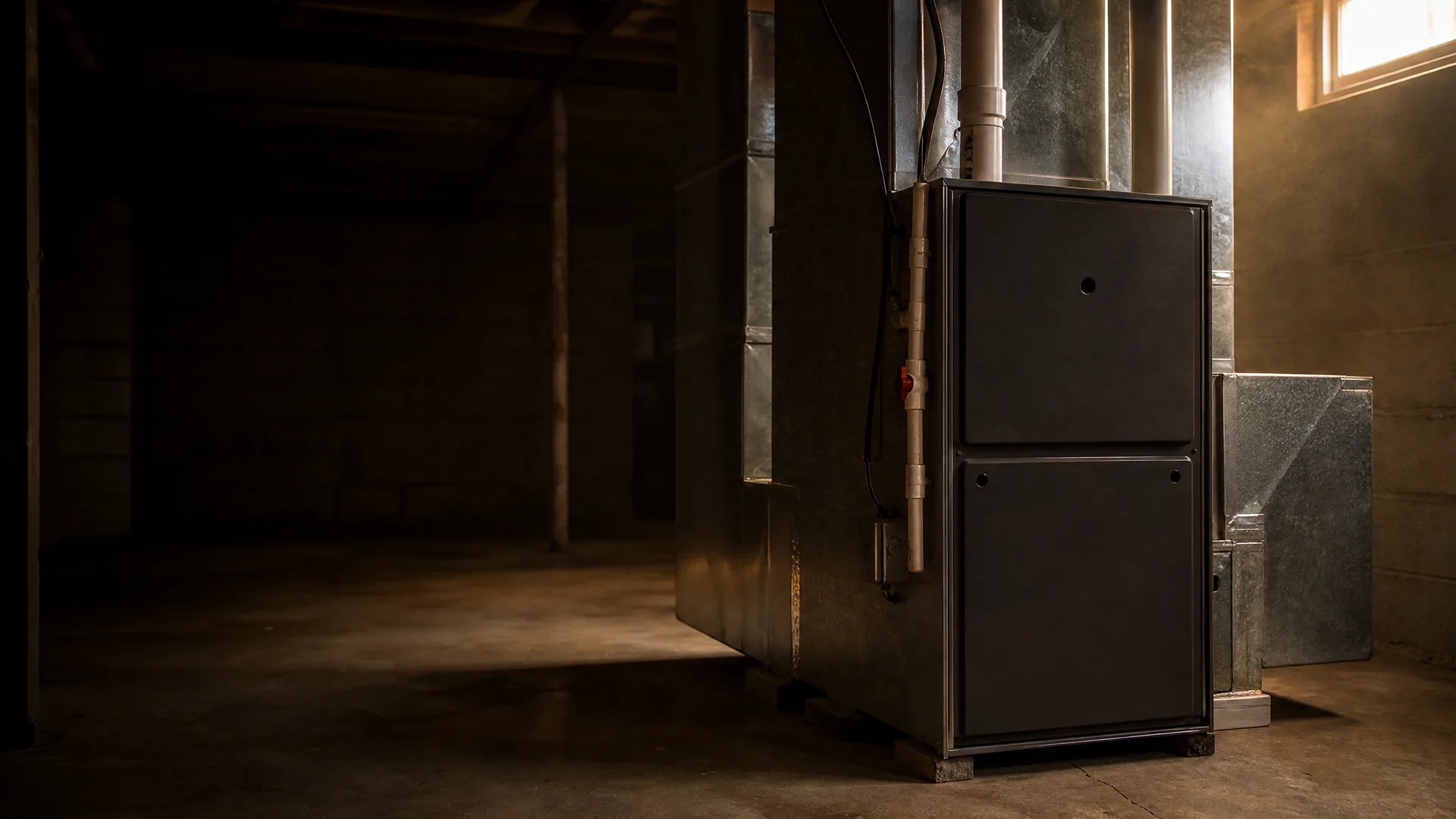
A dark residential basement with a concrete floor and block walls, containing a furnace with two access panels connected to galvanized sheet-metal ductwork and a white vent pipe, lit by a small window at upper right.

The basement is dark except for the glow of a phone screen. It's gone 9pm in November and the house has gone quiet and cold. Downstairs the furnace sits dead, no hum from the blower, no blue light where the burners should be. A thin haze of dust hangs in the air near the cabinet, stirred up when it kicked off last. The thermostat upstairs reads lower than it did an hour ago. Nobody's fixed on what to do yet, just standing there in a coat, waiting to see if it starts back up on its own, listening for a click that doesn't come.

A woman in a long cream cardigan and jeans stands at an open wooden front door of a gray shingled house with stone-based porch columns, with a second person visible inside, and potted flowers and shrubs beside the entry.

A furnace that shuts off early isn't going to sort itself out

A furnace that keeps cutting off has a reason, a dirty filter, a flame sensor that can't prove the flame is lit, a pressure switch that won't confirm draft, and that reason doesn't go away because the weather warms up for a day or two. Winter nights near Cabot sit cold enough that the furnace is working hard whenever it runs, and a unit that quits partway through a cycle is going to keep quitting until whatever part is causing it gets found and dealt with.

You don't have to be the one who figures out which part it is. Instead of calling around Lonoke County trying to find someone who can look at it, explaining the short cycling and the cold rooms over and over to different shops, and sorting through quotes on your own, you can get matched with a contractor who takes on jobs like this one and have them reach out to you directly about your furnace.

A large weathered ceramic vase and a shallow wooden bowl sit on a rustic wooden table beside a window with linen curtains, with a blurred sofa with cushions and a hanging fabric panel in the background.
A gray standing-seam metal roof with two stone chimneys in the foreground, framed by pine branches and moss-draped trees, overlooking misty forested hills and distant mountains under an overcast sky.

A furnace pro near you

Answer a few questions

No charge to send it. You decide if you hire them.

A furnace that keeps shutting off on a cold night in Cabot won't wait for a convenient time to get worse. Sending the request means you skip calling around and explaining the problem twice, and a contractor who knows the system gets back to you with what it'll take to keep the house warm through the night.