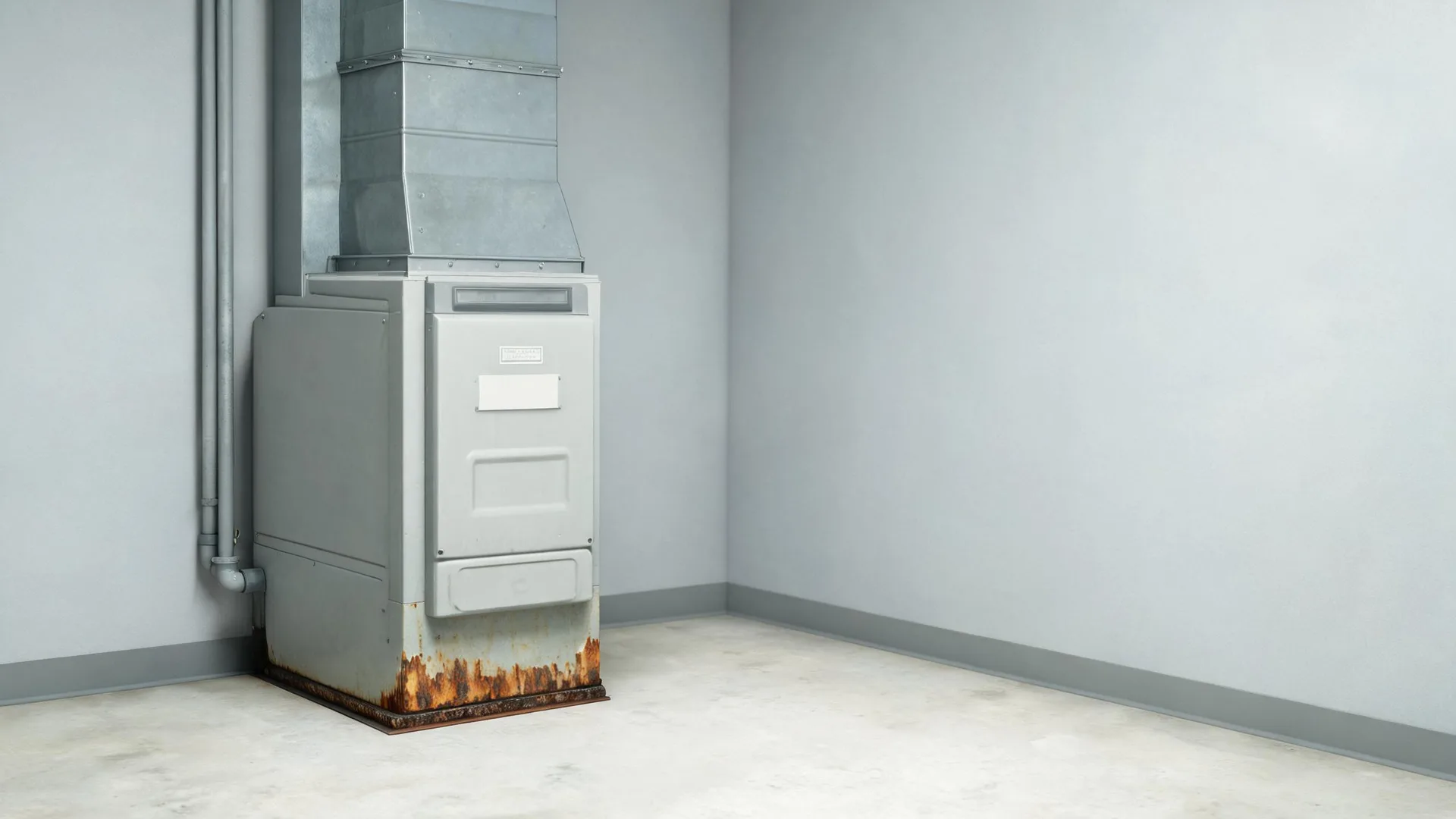
October is the month to get ahead of it
Furnaces here sit unused until November. When you switch it on for the season, whatever was already weak, a cracked igniter, a failing flame sensor, a worn capacitor, tends to show up in that first run.
Takes about a minute. No obligation.
Furnaces here sit unused until November. When you switch it on for the season, whatever was already weak, a cracked igniter, a failing flame sensor, a worn capacitor, tends to show up in that first run.
Heat season runs November through March, and the first cold week is when a weak part finally gets asked to work. A furnace repair now usually means catching something that was going to fail anyway, before it leaves you without heat on a cold night.

NOAA nClimDiv, 1991–2020 normals
Check the thermostat first. Make sure it's set to heat and the set point is above room temperature, and swap the batteries if the display looks dim.
Check the filter next. A filter clogged with dust can choke the airflow enough that the furnace shuts itself off before it finishes warming the house.




A tech who comes out for no heat starts simple. They pull the panel and watch the furnace try to run through a full cycle. If the igniter glows but the burners never catch, that points to the gas valve or the flame sensor, not the igniter itself. If it hums but never lights, they're checking for power at the board and listening for the inducer motor to start, because the control board won't open the gas valve until it sees draft. A dirty flame sensor reads as a bad one, so cleaning it is usually tried before anything gets replaced. They'll also check the limit switch, since a furnace that starts and then shuts off partway through its cycle is often overheating from poor airflow rather than failing on its own. None of this takes guesswork once the furnace is running in front of them. The hard part is usually catching the fault while it's happening, which is why a tech wants to see it cycle rather than just hear about it.
Problems tend to show up in the first weeks of the season, when the load hits a part that was already weak.
Find a contractor
A furnace rarely goes from fine to broken without saying something first. Short cycling is one of the clearest signs. It fires, runs a few minutes, shuts off, then starts again before the house has warmed up. That usually points to airflow trouble or a limit switch doing its job, cutting the burners before something overheats. A furnace that clicks like it wants to start but never catches is often an igniter that has lost strength, or a flame sensor too coated to prove there is a flame. Listen for the blower running longer than it used to, or air coming out the vents that feels cooler than it should. A yellow burner flame instead of blue means incomplete combustion, and that is not something to wait out. None of these build up slowly over months. They show up the first time the furnace runs a full cycle after sitting idle, and that first run is when a weak part finally gets found out.
An igniter cracks. A flame sensor coats over. A capacitor weakens. A limit switch trips early. These are separate parts doing separate jobs, and one failing doesn't mean the rest are going with it. A furnace that won't light and a furnace that lights and then quits are usually different problems with different parts behind them.
Starting up is what strains a furnace. The igniter has to heat, the inducer motor has to spin up, the gas valve has to open. Parts wear from the work they do, not from time passing. A furnace that barely gets used still wears the same way, just slower, and the part that was already weak is still the one that gives out first.
A furnace that short cycles or trips its limit switch is overheating somewhere in the system, and running it again doesn't give that heat anywhere new to go. The limit switch is tripping to protect the heat exchanger, and every cycle it has to step in is another cycle that metal gets stressed before its time. A flame sensor too coated to prove a flame will eventually stop proving it at all, and what started as a nuisance restart becomes a furnace that won't stay lit. A cracked igniter doesn't heal between cycles. It gets a little weaker each time it fires, until one morning it doesn't glow hot enough to light the burners at all. None of these get better with use. The part that is already failing is doing the same job every cycle, under the same strain that was wearing it down in the first place.
Most furnace repairs are worth doing. A furnace is a handful of parts working together, a gas valve, an igniter, a blower, and age on its own doesn't wear all of them out at once. If the cabinet, the heat exchanger and the ductwork are sound, replacing one failed part is usually the right call, not a stopgap. What changes the math is the heat exchanger. That's the one part that isn't simple to replace on its own, and a crack there is a safety issue, not just a repair job. A tech who finds the rest of the furnace sound but flags the heat exchanger is telling you something different than one who just needs to swap a sensor or a capacitor. Ask what part failed and why, and whether it's a part on its own or a sign the whole furnace is reaching the end of what it can do.